






Choose the result that matters most for this review period.
Free improvement review
Use feedback to drive continuous improvement
Connect a clear goal with an organised plan, verified results and practical changes that make the next cycle better.
Apply the success formula
Continuous Improvement Review
Use the eight questions to connect a clear goal with action, evidence, learning and the next improvement.
Saved on this device
Continue your previous worksheet?
A draft from this tool is stored privately in this browser. Restore it or discard it and begin with empty fields.
Load a worked example
Choose a complete example, then edit it to fit your situation.
Describe how you intend to achieve the goal.
Identify the first action and the order in which the work should happen.
Name the evidence that will show whether the plan is working.
Record the behaviours and conditions worth repeating.
Describe the shortfall without hiding or exaggerating it.
Use the evidence to define a practical corrective action.
Look for a way to strengthen or extend what is already working.
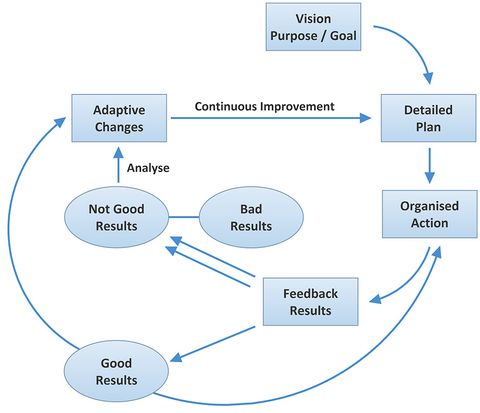
A repeatable management cycle
Improvement depends on accurate feedback
A goal and a plan describe what you expect to happen. Feedback shows what actually happened. Continuous improvement begins when a team compares the two without hiding disappointing evidence or overlooking the methods that produced good results.
The review separates two useful responses. When results are weak, identify the cause that can be influenced and adapt the plan. When results are good, identify the behaviour or condition that should be repeated, protected or strengthened.
Do not treat every difference as failure. New evidence may show that the original assumption, measure or target needs revision. The purpose is to improve future action, not to defend the first plan.
Run a useful review
Keep the conversation practical
Start with the goal
Evaluate results against a defined outcome rather than preference, blame or habit.
Bring evidence
Use measures, observations, customer feedback and completed work to test the plan.
Change the next action
Finish with a specific adaptation, an owner and a date for the next feedback review.
Interpretation and limits
Avoid vague lessons and uncontrolled changes
Statements such as “communicate more” or “try harder” are not sufficient improvements. Describe who will do what differently, what support they need and which evidence will show whether the change worked.
Change one important variable at a time when possible. If a team alters the target, process, staffing and measurement simultaneously, it becomes difficult to learn which action produced the new result.
Common questions
Continuous improvement FAQs
It is a repeating sequence: set a clear goal, write a plan, organise priority action, gather feedback, identify good and weak results, then adapt the plan. The worksheet turns that sequence into eight review questions.
Use a rhythm that matches the work. Operational teams may review weekly, project teams at milestones, and leaders monthly or quarterly. The review must be frequent enough to influence the next action.
No. Continuous improvement includes correcting weak results and strengthening good results. Questions five and eight deliberately identify what should be repeated or improved further.
No. The latest draft remains in local browser storage on the current device until you clear it.
Yes. Ask for evidence, record one agreed answer to each question, and finish with named actions and review dates.