







How to improve self-confidence?
The level of your self-confidence is one of the biggest factors that will determine your happiness and future success.
- If you feel a strong sense of self confidence then you will likely feel happier about the current situation, and you will more likely feel optimistic about your future success.
- But if you don't feel a strong sense of self confidence, then you will likely feel daunted about your current situation and you won't feel very optimistic about your chances for future success.
Self-confidence is crucial to your happiness, your personal effectiveness and the level of success in your interpersonal relationships.
So the important question is: how can you improve your self-confidence.
How to improve your self-confidence:
The first thing to do is to define what self-confidence is.
Self-confidence is an emotion. And all emotions are the products of your thoughts. Your thoughts are the sum total of your beliefs about any issue.
So your self-confidence is an emotional response to the sum of all the beliefs you have about your own abilities and nature when compared to the context in which you find yourself.
This means that your level of self-confidence is dependent on the following three things:
- How much knowledge you have in relation to the problem that you are facing.
- What you say to yourself when you are comparing yourself to the challenges that are facing you.
- What you say to yourself when you are comparing yourself to others.
So these three elements allow us to derive some good advice on how to develop more self-confidence. Let us take each element in turn.
1. How much knowledge you have in relation to the problems that you are facing?
You can gain more self-confidence by continually learning more valuable information relating to the achievement of your goals.
If you know that you don't know what you are doing, then how can you feel confident?
You can't!
And if you do know what you are doing, then you are bound to feel more confident.
So the first two methods for gaining self-confidence are these:
- Learn more. Learn as much as you can about the context in which you are being expected to perform.
- Prepare meticulously, in advance, for every important event.
2. What you say to yourself when you are comparing yourself to the challenges that are facing you
In the privacy of your own mind, you talk to yourself all day long. And what you say to yourself in your own mind will be the single most important determining factor that will affect your levels of self-confidence.
- If you think you will win, then you will feel confident
- If you think you can't win, then you won't feel confident
- If you think you can, you probably will be able to
- If you think you can't, you probably won't
Here is a most important statement. Mark it well.
Most people say, "I can't", too soon and too often.
Most people vastly underestimate what they are capable of.
When you next face a challenge, listen carefully to what you say to yourself and what you picture in your mind.
Whenever you are facing a problem or a challenging situation, you have a fundamental choice as to how you use your mind. You can either:
- Psych yourself up
- Psych yourself out
People with good levels of self-confidence have become experts at winning the silent war that goes on between the ears.
Confident people have learned how to psych themselves up. And they know that it is important not to psych themselves out.
On the other hand, people lacking in self-confidence do the opposite: NON Confident people have never learned how to psych themselves up. And they know exactly how to psych themselves out.
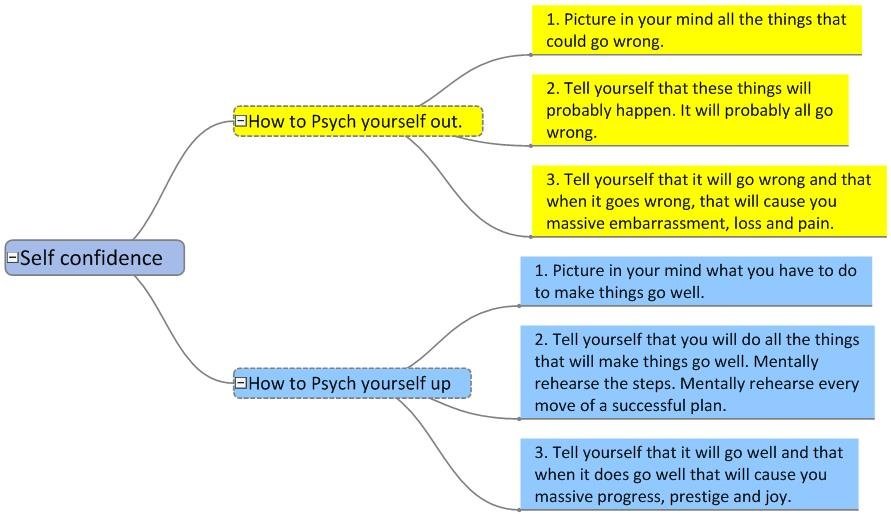
How to psych yourself out
Whenever a challenge or a problem occurs, all you need to do to psych yourself out is to do the following:
- Picture in your mind all the things that could go wrong.
- Tell yourself that these things will probably happen. It will probably all go wrong.
- Tell yourself that it will go wrong and that when it goes wrong, that will cause you massive embarrassment, loss and pain.
How to psych yourself up
Whenever a challenge or a problem occurs, all you need to do to psych yourself up is to do the following:
- Picture in your mind what you have to do to make things go well
- Tell yourself that you will do all the things that will make things go well. Mentally rehearse the steps. Mentally rehearse every move of a successful plan
- Tell yourself that it will go well and that when it does go well that will cause you massive progress, prestige and joy
3. In relation to comparing yourself to others
The third element is the issue of comparing yourself to others.
People who lack confidence often do that by thinking that other people are better than they are.
If you look around you will observe people who are better than you in every respect.
There are many people who are: Stronger than you. Faster than you. Better at maths than you. Better looking than you. There are many people who sing better than you; and who are richer than you. It is easy to be psyched out by other people.
The error here is to mentally compare yourself to the whole population.
If you mentally think of other people as being some kind of superman, then you will never measure up in your own mind, against "other people".
This error of over estimating other people and underestimating our own chances against "other people" (who are each all members of the superman class of being), is a classic mental miscalculation made by those people who lack confidence.
On the other hand, people who have self-confidence are not intimidated by other people; they don't think of other people as being superman. They do the opposite. They say, "So I am meeting the prime minister tomorrow? Fine. He is only a man. All men are only men."
Here is a belief system for you to consider:
Nobody is better than me. There are only better methods of performance
If a person is doing better than me, it is not because SHE is better. It is because her performance is better. If I can learn how to perform better, then I can beat anyone.
Then the issue turns back to point one. Training and preparation.
Don't think of others as superman.
See yourself as the equal of any person.
See yourself as being capable of learning to do anything you set your mind to.
Then you will develop more self-confidence.
Do you Psych Yourself Up or Out Questionnaire?
Try our Do you psych yourself UP or Out? Questionnaire to reveal what you are doing to yourself with your own self talk. Are you helping yourself to win, or to lose?
[personal Banner]
self-confidence
Self-confidence is the feeling that you can meet any task or test. In personal development it is an emotion built on four pillars: you hold a firm belief in your own ability; you gain knowledge and skill through study and practice; you run clear, hopeful talk in your mind; and you judge yourself on your own standard, not by others. Remove a pillar and the feeling falls.
CG4D Definition
Context: Personal development
Genus: Emotion
- Rooted in firm belief that you can cope with the present task
- Grows from knowledge and skill earned through study and practice
- Shows as clear, hopeful self talk that drives action
- Stands on judging your worth by your own standard, not by others
Article Summary
Self confidence thrives when you know your subject, talk to yourself with courage and measure growth by your own steps rather than by others; keep learning, plan well and back yourself, and belief will rise.