






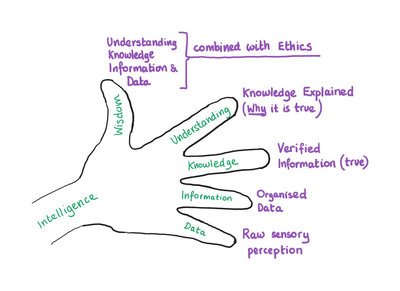
Intelligence - From Data to Wisdom
Why every leader, manager, coach, and trainer must know this model
Human intelligence has five clear levels. Each one rests on the level beneath it. When you grasp this shape, you can see where people slip, then guide them back on track.
Intelligence is the ability to use data, information, knowledge to develop understanding and wisdom. Wisdom is the highest form of human intelligence.
Hold up your hand. Each finger stands for a level of intelligence.
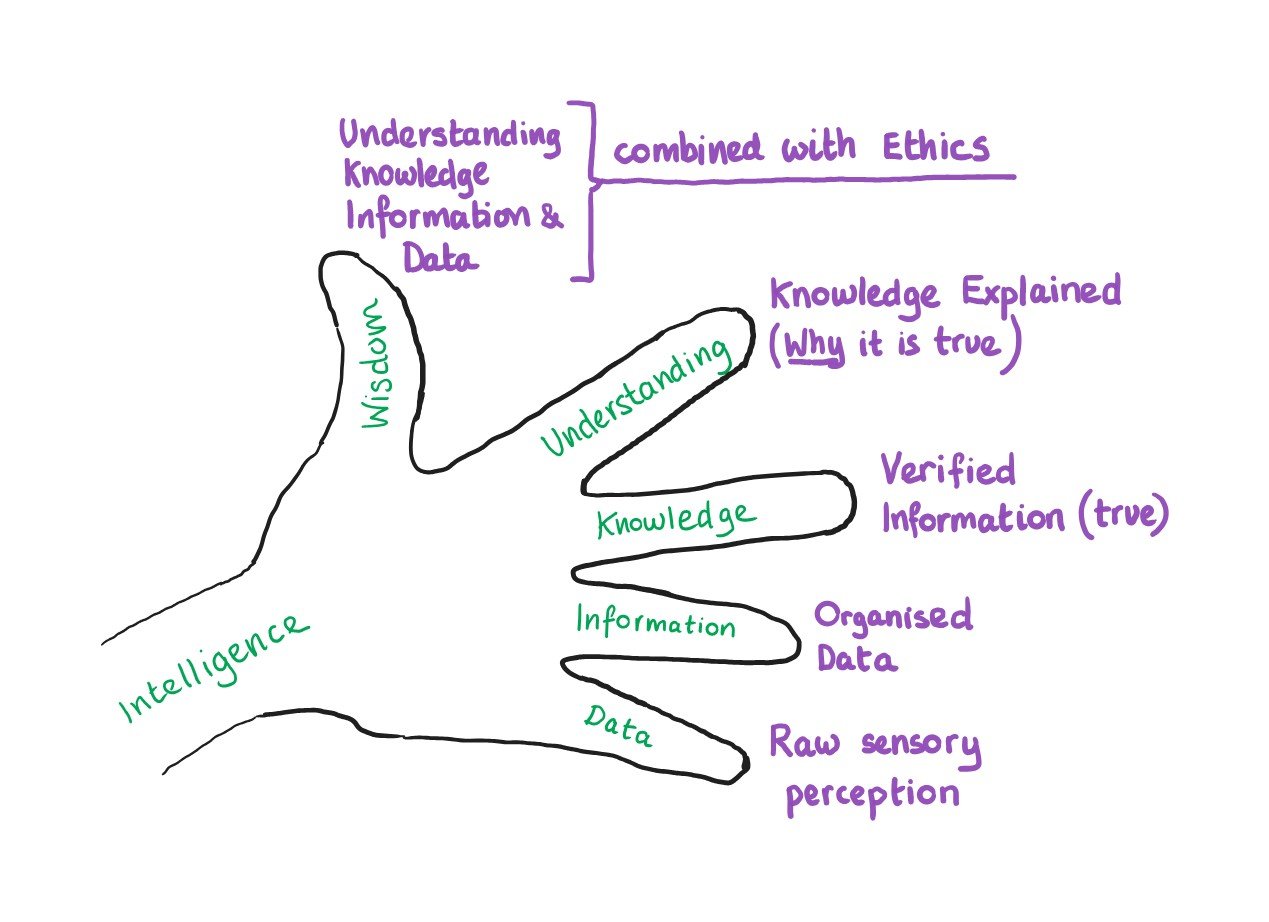
1. Data - little finger (base level)
Data is raw fact drawn from the senses. It carries no judgement.
Example in business: A retail chain may collect thousands of sales receipts each day. The raw numbers of "what was sold, when, and at what price" are data points. By themselves, they don't reveal much about customer behaviour.
2. Information - ring finger
When data is sorted, it turns into information. Information may still hold error or even deceit.
Example in business: When the retail chain sorts its sales data, it sees that "umbrella sales rose by 200% on rainy days." That pattern is now useful information. However, information can still mislead if taken out of context - perhaps the spike was due to a one-off promotion rather than the weather.
3. Knowledge - middle finger
Knowledge starts once we prove that information is true. It needs checks and tests.
Example in business: After comparing data from several months, the chain confirms that umbrella sales consistently rise on rainy days, even without promotions. This tested and verified pattern is knowledge. In another context, an HR department might notice from several exit interviews that staff leaving the company often cite poor communication from managers - once this trend is validated, it becomes knowledge.
4. Understanding - index finger
Understanding shows why the knowledge is true. It links causes, effects, and principles.
Example in business: The retailer digs deeper and realises that customers don't plan ahead for umbrellas - they buy them only when caught in bad weather. This explains why umbrella sales rise on rainy days. In another field, a manufacturer may understand that machine breakdowns spike after missed maintenance checks, showing the cause-and-effect link between prevention and reliability.
5. Wisdom - thumb (highest level)
Wisdom blends understanding with ethics. It guides us to act in ways that are right and useful. Wisdom lets us judge well in both life and work.
Example in business: The retailer decides not just to stock more umbrellas on rainy days, but also to act wisely by training staff to suggest related items, such as raincoats, while ensuring prices remain fair. In leadership, a CEO facing redundancies might use wisdom to balance financial necessity with compassion - offering generous support packages and honest communication.
Using the model at work
Leaders act at the level of wisdom. They base each choice on sound understanding rather than on loose data.
Managers make sure teams rely on proven knowledge, not half-true stories.
Role models show people how to think, test ideas, and read meaning.
Coaches and trainers lift people beyond knowledge toward understanding, then wisdom.
The best people do not stop at data. They climb the full ladder. They know what is true, why it is true, and how to use it with wisdom.
Data to Wisdom model
In leadership and management, the Data to Wisdom model is a five-step thinking map. It starts with plain data, turns it into information, tests it into knowledge, explains it for understanding, then applies it as wise, fair action. Each step must build on and prove the one before. Leaders use the map to spot weak links and improve judgement.
CG4D Definition
Context: Leadership and management
Genus: Model
- Maps cognition into five ordered levels: data, information, knowledge, understanding, wisdom
- Requires validation at each level before moving higher
- Shows a one-way, bottom-up conversion of raw facts into ethical action
- Guides leaders to diagnose gaps and steer decisions
Article Summary
Intelligence is a climb: gather clean data, shape it into information, test it into knowledge, explain it for understanding, then choose with wisdom; leaders who walk this ladder guide teams to actions that are both smart and fair.