






The Benefits of Following a Good Exercise Programme
To achieve your goals and be happy, you need to have enough energy!
Your body would respond well to a good exercise programme. Irrespective of who you are, your gender, your age, your goals or your condition.
Your situation would improve if you improved your physical health. And your health will be improved by the right exercise programme.
The meaning of "a good exercise programme" varies depending on you. If you are a young person who is already physically strong and with ambitions to be the best in the world, then your exercise programme would be radically different to an elderly person, who was recovering from a hip replacement surgery.
We are all different, but the principle is the same for everyone:
Your body would respond well to a good exercise programme.
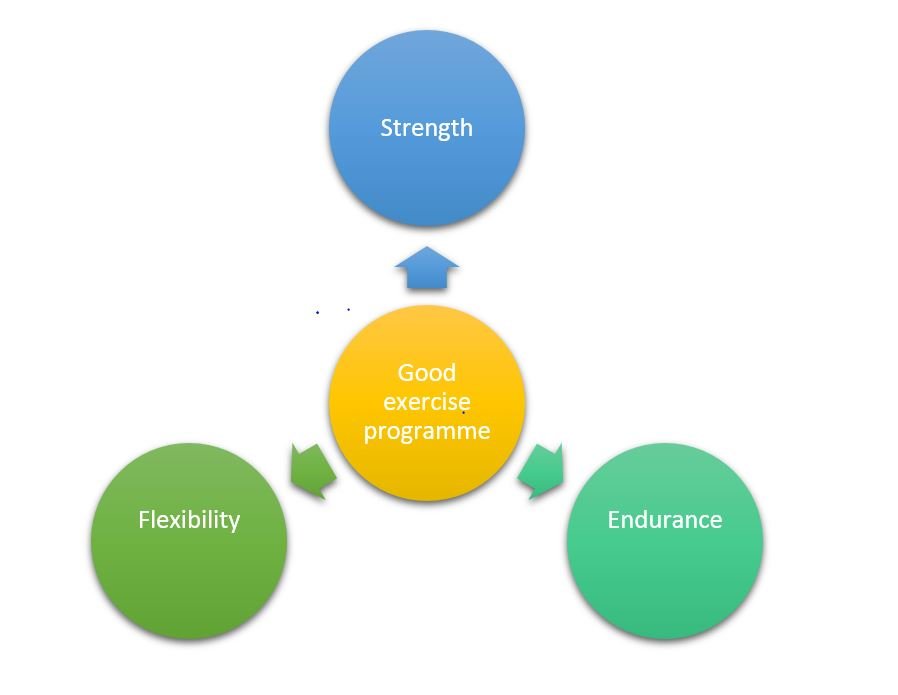
All good exercise programmes contain the same three basic elements.
- Strength.
- Endurance.
- Flexibility.
Each of these three elements of physical health can be improved by training.
Strength training.
Strength training involves pushing or pulling against a resistance that is heavy enough to induce a response. Your body is an adaptive organism that responds to the demands placed upon it.
The demand that the training places on your existing strength capacity, is such that it triggers your body to respond by developing more strength in preparation for the next training session.
This type of training includes, sprinting, hard swimming, lifting weights, chin ups, sit-ups, press ups.
Training hard, for a short amount of time. That is strength training.
Opposite to that is endurance training.
Endurance training.
Endurance training is long duration, but easier training. This is slow running, walking, jogging, slow gardening. It is the type of activity that can be maintained for hours without running out of energy. This is called aerobic activity.
This training is easy, it uses light weights, and is of long duration. It elevates your heart rate to a moderate degree and keeps it elevated for at least 20 minutes. This type of activity is good for the cardiovascular system, and overall fitness.
But it does not build strength, it builds endurance, staying power.
Endurance training and strength training are opposite and complementary training styles.
To round off your training plan you would benefit from some flexibility training.
Flexibility training.
Flexibility training is about improving the range of motion of your joints and the flexibility of your muscles, and tendons.
As you get older, your muscles tend to get shorter and less able to stretch. So, as you get older, you should add some stretching to your programme to improve your ability to use the full range of motion in all your joints.
Examples of good stretching and flexibility training is Yoga and swimming.
And of course, you can just bend down and touch your toes, if you are still able to do that.
A Good Exercise Regime
Remember, you can improve your health with a good exercise programme which includes strength training, endurance training and flexibility training.
good exercise programme
A good exercise programme is a planned routine that mixes short, hard strength work, longer, steady heart-and-lung tasks and daily stretch moves. It matches the age, skill and goal of the person, grows harder in small steps, and fits safely into weekly life. When these four traits are missing, the plan is no longer a good exercise programme.
CG4D Definition
Context: Personal fitness coaching
Genus: Programme
- Blends strength, endurance and flexibility sessions
- Matches the participant's age, ability and goal
- Uses steady, progressive overload and set schedule
- Maintains safety and supports long-term health and energy
Article Summary
A good exercise programme blends short, hard strength work, steady endurance tasks and daily stretching, so people of any age or aim build power, last longer and move with ease, boosting energy, mood and long-term health.