




Good leaders help other people succeed
Inspiring Others and Continuous Improvement: Follow On Training 4 hours
This four-hour follow-on course is part of the specialist series designed for delegates who have already completed the Leadership and Management Training two-day programme. The series provides a deeper, more applied focus on each of the six essential leadership skills. This session addresses one of the most demanding: helping other people succeed.
Available as live online training via Microsoft Teams, or as bespoke in-house training tailored to your organisation.
Course Overview
Inspiring others and continuous improvement
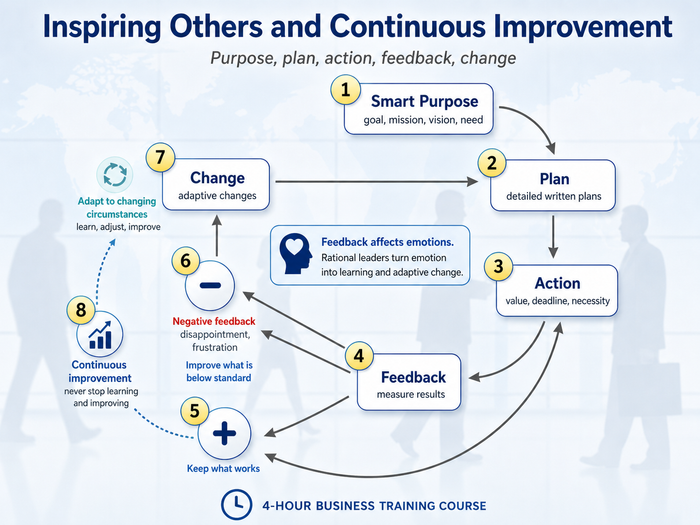
The course begins with the five-part success formula: Purpose, Plan, Action, Feedback, Change. Delegates who attended the two-day programme, or completed the setting and achieving goals follow-on, will recognise this framework. Here, the focus shifts from applying it personally to using it as a leadership tool. Delegates learn how to give people a clearer sense of purpose, help them connect that purpose to practical written plans, inspire them to take consistent action, and guide them through the feedback that sustains steady progress.
A significant part of the course is devoted to feedback. Positive feedback is relatively straightforward: it confirms what is going well and builds confidence. Negative feedback is more complex. Criticism, setbacks, defeats, and disappointments are inevitable parts of any improvement process, yet most people respond to them badly. They become defensive, lose confidence, blame others, or give up entirely. Delegates learn how to reframe these experiences as useful information rather than evidence of permanent failure. They also learn how to give constructive criticism that improves performance without undermining the recipient's self-belief.
Unlike the one-day Continuous Improvement Training course, which focuses on building improvement cycles and systems at team and organisational level, this follow-on programme centres on the human dimension of improvement. The question it addresses is not what system to use, but how to help people want to keep improving. Alongside practical feedback skills, delegates learn to recognise and interrupt the common failure pattern of drift, poor planning, procrastination, and stubbornness that prevents improvement from becoming a settled habit.
Core Skills
The Key Skills Covered
This course focuses on the leadership skills needed to inspire others and embed continuous improvement. Each section provides a practical method that delegates can apply immediately on returning to work.
-
1
The Success Formula
Success follows a repeatable pattern: Purpose, Plan, Action, Feedback, Change. This five-part formula is not only a personal tool; it is a framework for guiding others through the process of improvement. Delegates learn how to use each element as a leadership lever, supporting the people they lead from the initial definition of a clear purpose all the way through to the adaptive changes that make improvement continuous and self-sustaining.
-
2
Giving Others a Sense of Purpose
People who do not have a clear sense of purpose tend to drift, react to immediate pressures, and default to the path of least resistance. Delegates learn how to give the people they lead a specific and motivating sense of what they are working towards, why it matters, and how their contribution connects to the broader goal. Clear purpose, communicated well, is the foundation of inspired and consistent performance.
-
3
Positive Feedback and Recognition
Positive feedback is one of the most consistently underused leadership tools. When people receive clear, specific recognition for what they are doing well, they are more likely to repeat those behaviours and sustain their effort over time. Delegates practise identifying and delivering positive feedback that is genuine, specific, and directly connected to the behaviours and outcomes the team needs more of.
-
4
Reframing Negative Feedback
Criticism, setbacks, defeats, and disappointments are part of every serious improvement effort. The difference between people who progress and those who stall is not the absence of negative feedback but their ability to interpret it constructively. Delegates learn a practical reframing approach that converts negative experiences into actionable information, rather than treating them as evidence of permanent failure or personal inadequacy.
-
5
Giving Constructive Criticism
Poorly delivered criticism damages confidence, creates defensiveness, and rarely produces lasting change. Delegates learn a structured approach that is objective rather than personal, specific rather than general, and focused on the improvement required. This produces feedback that actually changes behaviour without undermining the recipient's self-belief or their willingness to keep trying.
-
6
Leading Continuous Improvement
Continuous improvement becomes real when it is practised consistently across the team, not merely acknowledged as a desirable aspiration. Delegates learn how to encourage and sustain this discipline, including how to identify and address the common failure pattern of drift, poor planning, procrastination, and resistance to adaptive change. The goal is a team environment in which improvement is expected, valued, and habitual.
Who Is This Course For?
Who Should Attend This Follow On: Inspiring Others and Continuous Improvement Course?
Designed for delegates who have already completed the two-day Leadership and Management Training programme and want to build a deeper capability in inspiring others and leading continuous improvement.
Leadership and Management Graduates
Deepen your capability in inspiring others after completing the two-day programme.
Team Leaders and Managers
Build practical skills for giving feedback and creating a team culture of improvement.
Supervisors and Project Leaders
Develop the confidence to handle feedback constructively and inspire sustained effort.
HR and L&D Professionals
Incorporate this follow-on into a broader leadership development programme.
Also valuable for team leaders and supervisors who want a focused, practical session on feedback and continuous improvement without first attending the two-day programme, and for HR and L&D professionals designing blended leadership development pathways.
Course Agenda
Follow On: Inspiring Others and Continuous Improvement Course Details
First Half • The Success Formula and Inspiring Purpose • The success formula, giving people purpose, helping them plan, and measuring progress
Understand how the five-part success formula applies to leading others. Learn how to give people a clearer sense of purpose, help them build practical written plans, inspire consistent action, and measure progress in a way that generates useful feedback.
Second Half • Feedback, Criticism, and Continuous Improvement • Positive feedback, reframing negative feedback, constructive criticism, and embedding improvement
Learn how to give positive feedback effectively, reframe criticism and setbacks as useful information, deliver criticism constructively, recognise and interrupt the failure pattern, and embed continuous improvement as a lasting team habit.
Availability and Pricing
Course Formats and Delivery Options
Choose from scheduled open follow on: inspiring others and continuous improvement courses, live online training or bespoke in-house follow on: inspiring others and continuous improvement training for your organisation. Each format covers the same practical methods and learning outcomes.
Online Live Training
£200 +VAT
per delegate
Interactive live sessions delivered via Teams using our superior green-screen technology.
- Same content as face-to-face
- Learn from home or office
- Delivered via MS Teams
- Laptop or tablet with webcam
Bespoke In-House
Enquire
per training day
We come to you. Training delivered at your premises, tailored to your team's specific needs.
- Your premises or online
- Tailored to your organisation
- Dates to suit your schedule
- We can train in your timezone
All Our Training Includes
Questions? Call 020 3856 3037 or 01452 856091
Upcoming Dates
Next Available Course Dates
No upcoming dates are currently listed.
Please get in touch to enquire about availability.
Please get in touch to enquire about availability.
Frequently Asked Questions
Course FAQs
Have a question that is not answered here?
Book This Course
Questions? Call us on
020 3856 3037Trusted by Leading Organisations
Companies We Have Trained
"Excellent content and each element valuable to my role. This training will be beneficial for both work and home life. The presentation was excellent. Chris new the presentation inside and out with great detail behind each element."
Colin Overall
Country Broadband
"I found the course very useful and took away many action points and methods, which I can and will apply, to become an inspiring leader and effective manager. Chris was very engaging and is clearly passionate and extremely knowledgeable about the topic. The Trainer was very clear, rational, positive and smart!"
Polina Shvarts
Tamsel UK Ltd
"The course content was fascinating, useful and concise. The trainer's presentation was engaging, interesting, funny, inspirational, knowledgeable, respectful, friendly, energetic, highly intelligent and draws on startlingly broad frames of reference."
Keir Ritchie
Imperial College Healthcare NHS Trust
Related Reading
-
How to Choose a Management Training Provider
Compare practical short courses, ILM or CMI qualifications and business school programmes, then use a checklist to choose the right training provider.
-
What Should a Good Management Training Course Include?
Learn what a good management training course should include: goals, communication, delegation, conflict, motivation and action planning.
-
What Is the Difference Between Leadership and Management?
Leadership sets direction, management organises action. Learn the difference and why good managers need both skills.
Ready to Inspire Better Performance in Your Team?
Book this four-hour follow-on session for your team and leave with practical tools to inspire others, manage feedback in both directions, and build a culture of continuous improvement.
Or speak to a member of our team directly: