




Stop Reacting. Start Leading With Purpose.
Setting and Achieving Goals: Follow On Training 4 hours
A four-hour follow-on training course for delegates who have completed the two-day Leadership and Management programme. Apply the eight-part SMART formula, connect goals to detailed written plans, and build the motivation to achieve results.
Available as live online training via Microsoft Teams, or as bespoke in-house training tailored to your organisation.
Course Overview
Setting and achieving goals
Many people do not set specific goals. Instead, they tend to react to whatever happens, feeling controlled by circumstances rather than shaping them. This four-hour follow-on course directly addresses that tendency. It is the first of six specialist programmes designed for delegates who have already completed the Leadership and Management Training two-day course and want to develop a deeper, more applied capability in each of the six essential leadership skill areas.
The course begins with the Corporate Coach Group success formula: clear purpose, rational plan, positive motivation. Clear purpose means knowing exactly what you want, and what others want. Rational means having a logical plan capable of achieving that purpose. Positive means having the motivation, persistence, and confidence to carry the plan through to completion. All three elements are interdependent: a goal without a plan is merely a wish, and a plan without motivation rarely survives contact with the first serious obstacle.
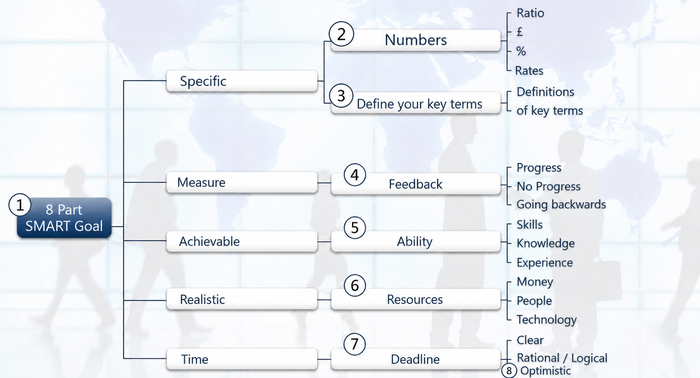
Delegates learn how to turn these principles into practical action using the eight-part SMART goal-setting formula. This extends the familiar five-element version to include specificity of language, numerical measurability, clarity of key terms, identification of required abilities and resources, and a firm deadline committed to in writing. Alongside goal-setting, delegates learn how to connect each goal to a detailed written plan, so that the goal becomes a concrete programme of work rather than an aspiration sitting in someone's head.
The session concludes by showing delegates how to sell their goals to others using the motivating power of benefits and the avoidance of painful consequences, and how small shifts in everyday language have an outsized effect on team confidence and focus. By the end of the course, delegates leave with a fully defined goal, a written plan, and the motivation to pursue it.
Core Skills
The Key Skills Covered
This course focuses on the first of the six essential leadership skills: clear purpose and goal focus. Each section provides a practical method that delegates can apply immediately on returning to work.
-
1
Defining Success Clearly
Success is defined as the achievement of a long-range, worthwhile, and valuable goal. We explore what that definition means in practice and how to distinguish genuine goal focus from vague aspiration or reactive drift. A clear and shared definition of success is the foundation of everything that follows.
-
2
The Eight-Part SMART Formula
The eight SMART questions extend the familiar framework to cover specificity of language, numerical measurability, clarity of key terms, identification of required abilities, resource planning, deadline-setting, written commitment, and personal ownership. Each question sharpens the goal and makes it more achievable in practice.
-
3
Connecting Goals to Written Plans
Goals without plans are meaningless. Clear goals and detailed written plans are the twin engines of progress. Delegates learn how to connect each goal to a practical, written plan that specifies what needs to be done, by whom, and by when, turning a vague aspiration into structured, trackable action.
-
4
Communicating and Selling Goals
A goal that the team does not understand or believe in will not be achieved. Delegates learn how to communicate goals clearly and persuasively by explaining the pleasurable benefits of achieving them and the painful consequences of failing to do so. This two-sided motivational approach is one of the most effective ways to secure genuine team commitment.
-
5
Motivational Language
The language we use shapes the way we think. Replacing weak, self-doubting phrases with stronger, action-oriented alternatives moves the mind away from hesitation and towards problem-solving. A question such as "How can we do it?" is far more productive than "Can we do it?" and produces measurably better results.
-
6
Positive Motivation and Confidence
Alongside clear purpose and rational planning, positive motivation is the third element of the success formula. Delegates learn how to build and sustain the confidence needed to pursue goals through difficulty, and how to use the same motivational principles to inspire their teams to commit and persist.
Who Is This Course For?
Who Should Attend This Follow On: Setting and Achieving Goals Course?
Designed for delegates who have completed the two-day Leadership and Management Training course and want to develop a deeper, more applied capability in goal-setting and clear purpose.
Leadership and Management Graduates
Deepen your goal-setting capability after completing the two-day programme.
Team Leaders and Managers
Gain a structured, practical method for setting and communicating goals.
Aspiring Leaders
Build the clarity and direction that effective leadership depends on.
Individuals Seeking Greater Focus
Replace reactive drift with a confident, goal-focused way of working.
Also valuable for team leaders and managers who want a focused, practical introduction to goal-setting without first attending the two-day course, and for HR and L&D professionals building a blended leadership development programme.
Course Agenda
Follow On: Setting and Achieving Goals Course Details
Part One • Defining and Setting Goals • Goal focus, the success formula, and the SMART framework
Establish a precise definition of success, understand the Corporate Coach Group success formula, learn how to avoid the most common goal-setting mistakes, and apply the eight-part SMART formula to a real goal from your own work.
Part Two • Planning, Communication and Motivation • Written plans, selling goals, and building team motivation
Learn how to connect goals to detailed written plans, identify the abilities and resources required, communicate goals compellingly to your team, and use language and motivation to sustain commitment through to completion.
Availability and Pricing
Course Formats and Delivery Options
Choose from scheduled open follow on: setting and achieving goals courses, live online training or bespoke in-house follow on: setting and achieving goals training for your organisation. Each format covers the same practical methods and learning outcomes.
Online Live Training
£200 +VAT
per delegate
Interactive live sessions delivered via Teams using our superior green-screen technology.
- Same content as face-to-face
- Learn from home or office
- Delivered via MS Teams
- Laptop or tablet with webcam
Bespoke In-House
Enquire
per training day
We come to you. Training delivered at your premises, tailored to your team's specific needs.
- Your premises or online
- Tailored to your organisation
- Dates to suit your schedule
- We can train in your timezone
All Our Training Includes
Questions? Call 020 3856 3037 or 01452 856091
Upcoming Dates
Next Available Course Dates
No upcoming dates are currently listed.
Please get in touch to enquire about availability.
Please get in touch to enquire about availability.
Frequently Asked Questions
Course FAQs
Have a question that is not answered here?
Book This Course
Questions? Call us on
020 3856 3037Trusted by Leading Organisations
Companies We Have Trained
"A very engaging course, lots to take away. At my current point of working life, a new leader/manager, I have learnt many techniques I can utilise, and also highlight bad habits. Chris was great, knowledgeable, engaging, approachable and fun to work with."
Phil Whitehead
Stroud District Council
"The course content was clear and very engaging. It made me think about how this training can improve and aid both my personal and work life. The trainer was very entertaining and the use of examples really aided the experience. Although a strong personality, he was not over-bearing and was very endearing and warm."
Efe Odeka
UHY Hacker Young LLP
"The course content felt quite packed, but not in a negative way. A lot of information was covered, which encourages revisiting the material in the coming weeks and months to fully appreciate and continue the learn. For me the time management and goal setting were most beneficial. Chris was calm and measured in his manner. He come across as confident and well versed in the material. He managed to present the information in a clear and precise manner, not once did it approach feeling overwhelming."
Brian Smith
Birmingham Hippodrome
Related Reading
-
How to Choose a Management Training Provider
Compare practical short courses, ILM or CMI qualifications and business school programmes, then use a checklist to choose the right training provider.
-
What Should a Good Management Training Course Include?
Learn what a good management training course should include: goals, communication, delegation, conflict, motivation and action planning.
-
What Is the Difference Between Leadership and Management?
Leadership sets direction, management organises action. Learn the difference and why good managers need both skills.
Ready to Set Goals That Actually Get Achieved?
Book this four-hour follow-on session for yourself or your team, and leave with a clear goal, a written plan, and the motivation to carry it through.
Or speak to a member of our team directly: