







The Difference Between a Wish and a Goal
Goals are the starting point of all achievement. Your goals define you. And you are defined by your goals.
Your goals, are not idle fantasies nor wishes. Your goals are more intelligently designed than mere wishes. Part of making your goals more intelligently designed is to ensure that they are constrained by being both achievable and realistic.
Some people ask, "What is the difference between a goal being achievable and it being realistic? Is that not just saying the same thing, twice? If a goal is achievable then isn't it realistic too, and vice versa?"
For example, I was in conversation with a gentleman, and I asked him my usual question, "What is your goal for the future?" He replied, "To win the national lottery!"
I thought, "That is not a goal, that is a wish!" Why is "Winning the national lottery" a wish, not a goal?
Because winning the national lottery is not something that depends on your daily performance. It is a pure chance event. So, we can safely assume that the lottery win is not a goal, but a wish.
Here is another example of a confusion between a wish and a goal.
I asked a lady at work my usual question, "What are your goals for the future?" She replied, "My goal is to be happy and successful".
Now, this reply sounds better than the lottery reply, but there is still something wrong with it. It is too vague. It is ill-defined. The statement is non-specific. We don't know what would make her happy and we don't know what would have to happen for her to define herself as being "successful". Maybe, she does not know herself, how she defines happiness and how she defines success.
Certainly, it is true that many people struggle to define these terms. Many people have big problems answering the question, "What does it mean to say that someone is happy?" and "What does it mean to say someone is successful?" Or to put it another way, "What goals, if you achieved them, would cause you to think that you were successful and would therefore make you feel happy?" or in other words, what are your goals?
The Definition of a Goal.
A goal (or purpose) is a specific statement of intent. Goals name the objective that our actions are intended to achieve. Goals may be tangible or intangible.
Tangible goals are those that consist of material things, such as a nicer house, or car, or a gold medal at the next competition, or a pass mark in the next exam.
Intangible goals are those things that are immaterial, such as more confidence, or more harmonious relationships with a loved one; or the goal may be gaining new skills and abilities.
Goals are powerful tools for change. Goals give you something to aim for and therefore something around which to gather your forces. Goals are a call to action. Goals give you hope for the future, they give you focus, motivation; something to plan for. Goals are to be taken seriously. They provide you with forward momentum. They provide you with meaning, and they map out the route for a better future. They give you a personal identity. You are defined by your goals, because, you become whatever you think about. Goals give you something interesting to think about when you are alone, and something interesting to talk about when you are with others. You should talk about your goals and ask others about their goals.
Wishes are not goals.
On the other hand, wishes are not goals. Wishes are idle fantasies, detached from reality. They may be figments of the imagination. They can be pleasant diversions and may give temporary relief from the demands of the real world. But wishes are not calls to action, it is a dream. "I wish I could lose weight. I wish I didn't have to go to work. I wish I had the answers for the next exam. I wish I could go back in time and do it differently. I wish I had more confidence."
Wishes are not goals, unless the person translates them into the form of a goal.
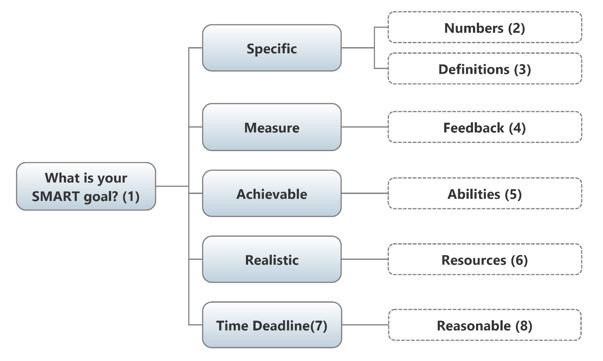
Once you have decided on a goal rather than a wish, you need to ensure the goal is achievable and realistic.
Achievable Goals
Achievable by reference to your abilities, the person who has the goal. Almost all your goals will require that you increase your mental abilities in some way. You may need to increase your skills, knowledge and understanding. So, whenever you set a goal, make a list of all the skills, knowledge and information you will need to obtain, in order to achieve the goal. Then, make it a priority to find out.
If you don't know enough, then your goal will forever elude you. The more you learn about your goal, the more achievable it becomes.
Realistic Goals
Realistic relates to resources. Resources are things in the external environment. Resources means physical resources, those material things and people to which you will need to gain access, in order to achieve your goal.
In terms of physical resources the major sets are: Other people, money and technology.
If you have the right people around to help you, and if you have sufficient cash to implement your plans, and if you have access to the right technology, then you have a better chance of achieving your goal.
Set Your Goals With Our App
We have developed this smart Goal Setting app, for you to use to set your goals. Try it out for free and use it whenever you need to set goals.
goal
In business life, a goal is a clear objective you choose that 1) spells out an exact end point, 2) rests on your own daily action not luck, 3) can be reached by gaining the skills you plan for, and 4) matches the money, people and tools you can secure.
CG4D Definition
Context: Business
Genus: Objective
- States a specific end point
- Depends on personal action rather than chance
- Requires planned skill growth and effort
- Is realistic in view of current resources
Article Summary
A wish relies on luck; a goal relies on you. Turn every hope into a clear, written target, then test it: do you have the skill to reach it and the resources to make it real? If both answers are yes, break the goal into steps and act each day until success follows.