







Better People Management Skills
One of the best things you could do is to improve your people management skills.
You'll progress more quickly if you can gain the willing cooperation of others; and the more cooperation you can get from others; the more progress you will make.
So improving your people management skills will help you to make more progress towards your goals. At home too, your happiness is directly related to how much cooperation you can get from your family.
Imagine a world where you have fantastically well-developed people management skills; so that every person will willingly work with you to make the current situation better? What a wonderful world that would be.
How can you develop better people management skills?
You can start by breaking the question down into smaller sets, and taking each set at a time. People management is made up of six major sets: which, when combined, form the whole.
If you improve on one set, then your people management skills improve a little. If you improve all six sets, then your people management skills will go through the roof.
What are the six major people management skills?
Here they are:
1. Identify the Goal.
You could define the word, "success" as "the achievement of a goal". And if you want to develop better people management skills, the first thing to become good at, is to find out what it is that the other person wants.
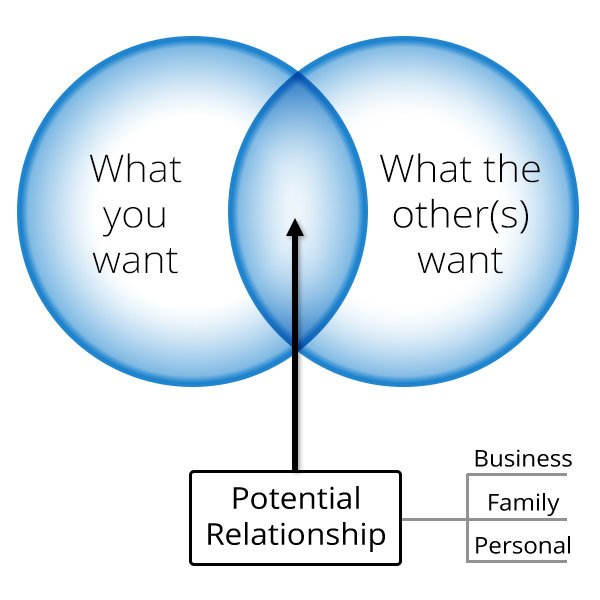
You need to know what the OTHER person wants: and you need to know what YOU want.
If you know both what you want, and what the other person wants, then you have the basis for a great relationship.
If you can give the other person what they want, in return for them giving you what you want, then you will gain their willing cooperation.
All successful relationships are based on a mutual exchange. Meaning, both sides benefit from the relationship. If one person is gaining from a relationship at the expense of the other, then something is wrong and the relationship won't last.
If you want to master the art of better people management, then master the art of finding out what the other person wants and then give them what they want in exchange for what you want.
This is the basis of all human society: Mutual help to achieve goals.
2. Communication skills.
In order to understand and gain the cooperation of others, you will need to master the art of communication; particularly the art of the spoken and written word. You need to master language. You need to master the art of verbal and written communication. You need to develop the word-power sufficient to allow you to express your exact meaning.
If you know what you mean but cannot explain it, then your life will be fraught; full of misunderstandings, confusions and errors.
If you know what you mean and you can explain it well, then your life will be fun: full of plans, progressive actions and achievements.
It is not a mere coincidence that great leaders are also often great communicators.
If you want to be a great leader, please consider improving your communication skills.
3. Planning skills.
If you want to help people achieve goals, and if you want to achieve your own goals, then it would be beneficial for you to improve your planning skills.
Planning skills includes: preparation, prioritisation, prevention and organisation skills. If you want to get the best from others, and help them to achieve goals then you need to come up with a practical plan.
Planning is good. Not planning is not good.
Not planning means you have to make it up as you go. Not planning means you have to fly by the seat of your pants.
Planning ahead is a must-have skill.
4. Rational conflict management skills.
Conflict is inevitable. You are bound to get some. The reason conflict is inevitable is that not everyone agrees with your views. Other people have their own views and so, inevitably, conflict will sometime occur.
Because conflict is inevitable, you need to develop skills at handling conflict, rationally.
Handle conflict situations according to the principles of REASON.
Do not allow conflict to degenerate into an emotional clash. Many people become emotional in conflict situations. That means anger and upset.
But we don't want angry, upsetting conflicts. We want rational, logical conflicts. Learn how to deal with conflict logically, rationally and professionally, and not allow it to become emotional, angry and upsetting.
If you can learn rational conflict management skills, then you will have improved your people management skills.
5. Self-control.

If you hope to manage others, you will need first to know how to manage yourself.
If you cannot manage yourself, then you have no chance of learning how to manage others. You need to develop self-control.
If you can control your own mind, control your own temper, control your own reaction, control your own work, control your own food intake, control your own fears, and control your own desires; then you will be in a good position to control the situation around you.
But if you cannot control yourself, then you won't be able to control the situation around you.
If you want better people management skills the first person to work on is yourself.
Work harder to improve yourself than you do on the others.
6. Inspiration.
If you want to develop good people management skills, then work on your ability to inspire others with a positive mental attitude.
Don't be too gloomy.
Don't be too glum.
Strive to be happy.
Shine like the sun.
Keep the conversation away from talking about the following three things:
- All the bad things that have happened in the past.
- All the bad things that could conceivably happen in the future.
- All the bad things that are happening in the world, right now.
Instead of that, purposefully restrict your conversation to the following three sets.
- What is the goal you want to achieve today?
- What is the plan that will help you to get what you want?
- What are the first practical steps we can take?
Your role is to inspire positive emotions in the minds of others, and you do that by being sensitive to the content of your conversations.
Have conversations that amount to one thing, "How the future can be made to be better than the past."
If you can get into the habit of talking in terms that continually suggest that the future will be better than the past, then you will inspire others.
So try to do that as a conscious skill.
Summary.
If you want better people management skills, then please attend our Leadership and Management course that covers these six skill sets:
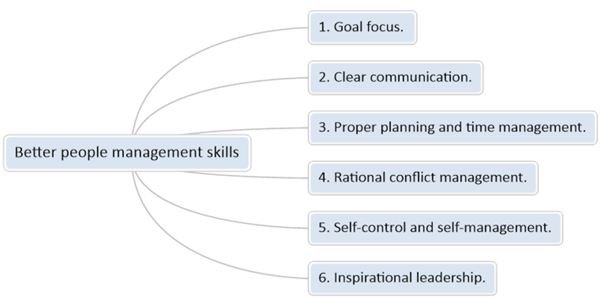
- Goal focus.
- Clear, concise communication.
- Proper planning and time management.
- Rational conflict management.
- Self-control and self-management.
- Inspirational leadership.
[leadership quiz button]
[elm Banner]
People Management Skills
In business, people management skills are a set of skills that help a leader gain willing help from others. They stand on four parts: clear shared goals, plain two way talk, careful plans with fair conflict rules, and strong self control that lifts hope. Remove any part and true people management breaks down.
CG4D Definition
Context: Business
Genus: Skill set
- Gains willing help by matching team and leader goals
- Uses clear, plain speech and listening
- Sets careful plans and handles conflict with reason
- Shows strong self-control and spreads hope and drive
Article Summary
Great people management skills turn shared goals into steady action. When you set clear aims, speak with clarity, plan well, solve conflict with reason, show self-control and lift others with hope, you win willing support that drives progress and boosts happiness at work and at home.