






How to cure people of cynicism
Managers and team leaders often ask the same question.
"What can I do about the cynics in my team who always have a negative attitude? How can I get them to change?"
First, we must define our terms.
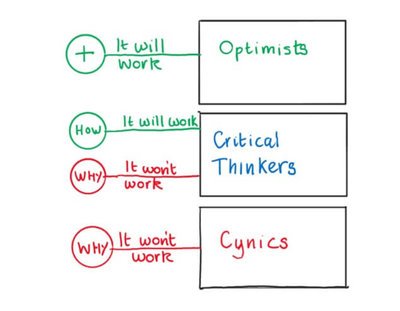
- An optimist is a person who believes everything will work out fine and resists criticism of ideas.
- A critical thinker tests ideas, removes weakness and then offers better alternatives.
- A cynic is a person who attacks ideas but does not offer anything better.
Cynics usually do not know they are being cynical.
They think they are being realistic.
They say, "I am not being negative. I am just being realistic."
They do not see that proper criticism has three steps.
To criticise an idea correctly, we must:
- Say that the idea is wrong.
- Explain why it is wrong.
- Suggest a better alternative.
If we do all three steps, we are critical thinkers.
We are valuable to the team.
If we do only the first two steps, then we are cynics.
We kill the idea, but we do not replace it.
We call this "being realistic" because we give reasons, but we still fail to help.
Telling someone that their idea is no good, and explaining why, has only limited value.
It becomes useful only when we can suggest something better in its place.
Optimists have the opposite problem.
They think that to criticise ideas is negative.
They say, "Stay positive. Do not pick holes in the plan."
This is dangerous.
If we refuse to test ideas, we keep weak ideas.
Weak ideas fail in the real world.
Critical thinkers take the middle position.
They know that success is possible but not guaranteed.
It depends on what we do.
If we do the right things and avoid the wrong things, we win more often.
This mindset is rational optimism.
How can we move a cynic towards critical thinking?
We stop rewarding them for doing only the first two steps.
We insist on the third step: the better idea.
When a cynic says, "Your idea will not work," we do not ask, "Why not?"
We ask, "What will work?"
If they say, "I do not agree with that plan," we do not ask, "Why do you not agree?"
We ask, "What plan do you agree with?"
So, instead of asking, "Why not?" we ask, "If not, then what?"
"What is your practical alternative?"
"What idea do you have that will work?"
At first, many cynics struggle to answer.
They are used to thinking in objections, not in solutions.
If we keep asking for practical alternatives, we start to train their thinking.
We move them away from pure negation and towards constructive, critical thought.
That is how we turn cynics into critical thinkers and build teams of rational optimists.
#LeadershipSkills #CriticalThinking #Cynicism #RationalOptimism #TeamCulture #ManagementTraining #WorkplaceCulture #PositiveChange #CommunicationSkills #PeopleManagement
critical thinking
In business, critical thinking is the process of testing an idea, exposing its weak points, and then giving a stronger, workable plan, all while holding the calm belief that success is still possible when the right steps are taken.
CG4D Definition
Context: Business management
Genus: Process
- Tests ideas in a clear, ordered way
- States each weakness with evidence
- Supplies a practical, stronger alternative
- Keeps rational optimism about success
Article Summary
Cure workplace cynicism by refusing lone complaints and requiring each criticism to end with a workable fix; this shift turns moans into critical thinking and grows a culture of rational optimism.