






Rational Optimism: A Philosophy of Hope For the Future
Rational optimism is a state of mind that allows us to remain optimistic no matter what. It's not blind hope-it's based on finding reasons to be optimistic. There are always reasons to be optimistic, and here are the two most important ones.
1. Most People Are Good
The vast majority of people are good. Most people are honest, hardworking, and mean no harm. If you want proof of this, just look at the London Underground during a busy day. It's packed with people, but everyone cooperates naturally. We behave in an orderly way, and trouble is rare.
Now imagine you could snap your fingers and replace every person on the Underground with a chimpanzee. Chimpanzees are 99% genetically similar to us, but the difference is clear. Within minutes, the chimpanzees would be eating each other. Human beings, by contrast, are cooperative, polite, and helpful. That is our nature for the vast majority of the time.
2. Technology Keeps Improving
Technology always gets better. It improves faster and faster, and it allows fewer people to create more goods and services at lower prices.
Cars were once so expensive that only the very rich could afford them. Now even poor people can buy a car. Televisions used to be a luxury, but now everyone has a television. In fact, we even have televisions in our pockets. The phones in our pockets have more computing power than the spaceship that went to the moon.
Technology gives people access to information and opportunities. Anyone with a laptop can start a business and run it from home-or even from a cafe. Technology is proof that things get better over time, making life easier and more productive.
The Line and the Sine Wave
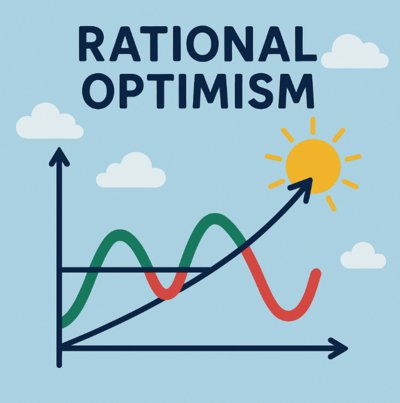
Picture a straight line stretching from the past to the future. At the end of the line is a better future. This line represents progress. Along the line, there is a sine wave that moves up and down. The parts of the wave above the line are green and positive. The parts below the line are red and negative.
The sine wave shows the ups and downs of life. But even though there are downs, the line itself keeps moving upwards. This is the story of progress.
Why We Notice Negativity
The human mind notices the negative more than the positive. Bad things feel threatening, so we pay more attention to them. This was useful for survival because it helped people avoid danger. But it also makes the world seem more negative than it really is.
The truth is, the world is full of positive events too. Most of the time, we don't notice them because they aren't threatening. For example, if you stub your toe, you notice the pain immediately. But you don't think about the nine toes that are fine. In the same way, the negatives of life stand out, while the positives are taken for granted.
The Bigger Picture
Over the long term, the world gets better. If you look back over ten years, you can see how technology has improved, living standards have risen, and opportunities have expanded. Life is full of ups and downs, but the overall trend is always towards progress. People are good, and technology is improving.
This is the philosophy of rational optimism. The image of the line and the sine wave shows that while there are always challenges, the future is moving towards something better.
A Challenge for You
Think about what I've said. Check to see if it's true. If it is, then adjust your thinking. Let this philosophy help you feel more optimistic, even when the world seems full of negativity. Rational optimism gives you a way to focus on the truth: humanity is good, technology is improving, and the future is bright.
rational optimism
Rational optimism is a mindset for personal growth in business. It builds hope on clear facts, sees the long-term rise in human life, accepts short-term trouble without panic, and urges useful action towards a better future. Lose any one of these traits and you slip into either blind faith or gloomy doubt.
CG4D Definition
Context: Business
Genus: Mindset
- Builds hope on clear facts, not wishful thinking
- Tracks long-term upward trends in human life
- Accepts present problems without panic or denial
- Prompts positive action toward a better future
Article Summary
Rational optimism uses clear facts to beat fear: most people act with kindness, technology keeps lifting living standards, and though life swings up and down the long trend points steadily towards progress.