




Speak clearly, Listen well, Be understood
Clear Communication: Follow On Training 4 hours
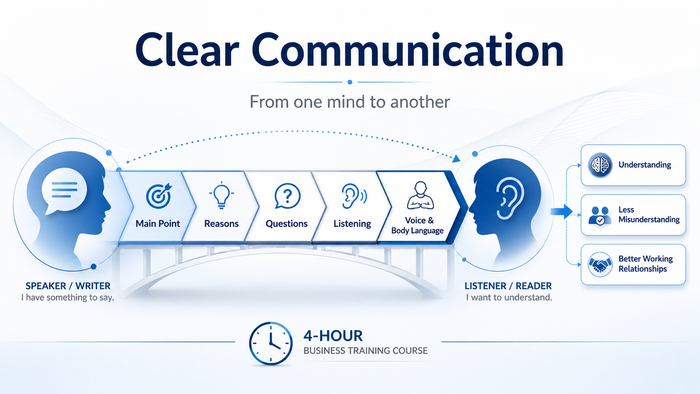
Good communication is the accurate transfer of information and emotion from one mind to another. Most workplace misunderstandings stem from poor structure, not poor effort. This four-hour session gives delegates a method for organising messages, listening with intent, asking the right questions, and using voice and body language effectively.
Available as live online training via Microsoft Teams, or as bespoke in-house training tailored to your organisation.
Course Overview
Clear Communication Course Overview
The course covers four interconnected areas: speaking, writing, asking questions, and listening. In each area, delegates learn a concrete method they can apply immediately on returning to work. They learn how to organise a message so the main point is clear from the outset, how to support it with reasons and evidence, and how to reach a definite conclusion rather than trailing off. They also examine the common errors that undermine otherwise well-intentioned messages, including leaving the main point implied, using vague language, and presenting information in an order the listener has to reconstruct themselves.
A substantial part of the session is devoted to listening with intent to understand. This is a disciplined form of listening in which the delegate withholds agreement, disagreement, and their own reply until they have genuinely understood what the other person means. Alongside this, delegates practise asking questions that clarify rather than interrogate, building the kind of two-way exchange that reduces misunderstanding and builds trust. Delegates who have attended the Leadership and Management Training two-day programme will recognise these ideas from the communication skill area and leave with a deeper, more applied command of them.
The session concludes with an examination of how voice tone and body language affect the way a message is received. Small changes in pace, posture, eye contact, and expression can shift a listener's interpretation significantly, and delegates learn to use these channels consciously rather than leaving them to chance. Unlike the full-day Communication Skills Training course, which also covers conflict handling, assertiveness, and the role of praise, this follow-on focuses exclusively on the four core communication channels and the errors that disrupt them, making it ideal as a short, targeted intervention or as a standalone introduction to clearer written and spoken feedback.
Core Skills
The Key Skills Covered
This course is built around four practical communication skills. Each section provides a concrete method delegates can apply immediately in their next real conversation or written message.
-
1
Speaking Clearly
Before speaking, clear communicators structure what they want to say around a main point, supporting reasons, and a defined conclusion. Delegates practise applying this three-part organising habit to realistic work situations, from a brief instruction to a team briefing, so that the listener receives a complete and coherent message rather than a stream of related thoughts.
-
2
Writing With Precision
Written messages fail when the main point is buried, the structure is unclear, or the reader has to guess at the intended meaning. Delegates learn how to open every written message with a clear statement of purpose, order the supporting points logically, and close with a defined action or decision. The same principles apply whether the message is an email, a briefing note, or a set of instructions.
-
3
Asking the Right Questions
The right question at the right moment prevents a misunderstanding before it takes hold. Delegates learn the difference between questions that clarify meaning and questions that invite a defensive response, and practise a questioning sequence that draws out accurate information efficiently without creating the impression of an interrogation.
-
4
Listening With Intent
Listening with intent means treating the other person's words as the primary source of information rather than a prompt for your own response. Delegates examine the specific habits that interrupt genuine listening, including anticipating what the speaker is about to say and filtering new information through existing assumptions, and leave with a practical method for replacing them with attentive, receptive listening.
-
5
Voice Tone and Body Language
Words carry meaning; tone and body language carry feeling. Pace, posture, eye contact, and facial expression all affect how a spoken message is received, often more powerfully than the words themselves. Delegates learn how to use these channels consciously, ensuring that what they say and how they say it work together rather than pulling in different directions.
-
6
Avoiding Communication Errors
Many communication breakdowns follow recognisable patterns: the main point is left implicit, the message wanders without a conclusion, or the speaker reacts to a meaning the other person never intended. Delegates identify the errors most common in their own communication and leave with specific corrective habits to replace them, reducing confusion and the rework it causes.
Who Is This Course For?
Who Should Attend This Follow On: Clear Communication Course?
Designed for anyone whose work depends on making themselves clearly understood and genuinely understanding others.
Managers and Team Leaders
Communicate instructions, expectations, and feedback with greater precision and fewer follow-up conversations.
Customer-Facing Professionals
Reduce misunderstandings with customers and improve satisfaction through clearer, more structured dialogue.
Supervisors and Front-Line Staff
Build the communication habits that help day-to-day interactions run more smoothly and with less rework.
Anyone Who Works in a Team
Develop the listening and questioning skills that underpin effective collaboration and mutual understanding.
Also valuable for HR and L&D professionals building a blended communication development programme, and for customer-facing teams where clarity of message has a direct impact on customer satisfaction.
Course Agenda
Follow On: Clear Communication Course Details
First Half • Speaking, Writing, and Common Errors • Message organisation and the causes of communication breakdown
Establish a working definition of effective communication, learn how to organise spoken and written messages for maximum clarity, and identify the common errors that cause confusion, delay, and conflict.
Second Half • Listening, Questioning, and Tone • Listening with intent, clarifying questions, and the role of voice and body language
Develop the listening and questioning habits that prevent misunderstanding from taking hold, and learn how voice tone and body language shape the way every message is received.
Availability and Pricing
Course Formats and Delivery Options
Choose from scheduled open follow on: clear communication courses, live online training or bespoke in-house follow on: clear communication training for your organisation. Each format covers the same practical methods and learning outcomes.
Online Live Training
£200 +VAT
per delegate
Interactive live sessions delivered via Teams using our superior green-screen technology.
- Same content as face-to-face
- Learn from home or office
- Delivered via MS Teams
- Laptop or tablet with webcam
Bespoke In-House
Enquire
per training day
We come to you. Training delivered at your premises, tailored to your team's specific needs.
- Your premises or online
- Tailored to your organisation
- Dates to suit your schedule
- We can train in your timezone
All Our Training Includes
Questions? Call 020 3856 3037 or 01452 856091
Upcoming Dates
Next Available Course Dates
No upcoming dates are currently listed.
Please get in touch to enquire about availability.
Please get in touch to enquire about availability.
Frequently Asked Questions
Course FAQs
Have a question that is not answered here?
Book This Course
Questions? Call us on
020 3856 3037Trusted by Leading Organisations
Companies We Have Trained
"I found the course thought-provoking and it has given me lots of ideas to improve my work and personal life. The trainer Marco made the course enjoyable. His energy and enthusiasm were tangible. "
Sean Donohue
H V Wooding
"I found the course content relates a lot to a lot of what I felt I already knew, which clearly did not. All aspect where really helpful. Especially having to deal with conflict, which I’ve not had experience in the workplace to date. Chris was Brilliant! Very precise and clear of what he was trying to get across and what is expected of me. "
Steve Devlin
Oldham Seals Ltd
"Very helpful concepts, extremely well organized and practical for our personal and work life. Exercises are very hands-on and helped grasp the material better while reflecting on real life examples. Chris is an amazing, inspiring presenter. He kept us engaged the whole day. Answered all questions and 100% knowledgeable of the subject he was presenting. An excellent, passionate presenter. "
Emma Kolitsi
Kings College London
Related Reading
-
Barriers to Communication in the Workplace: 7 Practical Solutions
Learn what barriers to communication in the workplace are, see seven common examples, and use clear practical steps to improve team communication.
-
A Six-Step Formula for Great Conversations
Learn a six-step formula for great conversations: ask about now, reveal gains and pains, bridge the gap and stay on them. Sharpen conversation skills fast.
-
The NLP Meta Model
Learn the NLP Meta Model and spot deletions, distortions and generalisations. Ask smart questions, remove confusion and drive clarity at work and in life.
Ready to Communicate With Greater Clarity?
Book this four-hour follow-on session for yourself or your team, and leave with the habits, structure, and confidence to make every message count.
Or speak to a member of our team directly: