






Time Management Skills: Planning Ahead
One of the best things you could do for yourself is to develop the discipline of planning ahead
Planning ahead is the best way to improve your time management skills.
Planning ahead is the best way to maximise your personal effectiveness.
Planning ahead will allow you to make more progress, in less time and effort.
NOT planning ahead sufficiently is why you sometimes fail.
NOT planning ahead is why you are not doing as well in life as you think you could.
By the way; not many people do as well in life as they think they COULD, because most people forget two vital things:
- They forget to decide exactly what they want out of life and..
- They forget to sit down and write out detailed written plans of action designed to get them exactly what they want out of life.
Most people don't have specific goals and most people don't have detailed written plans.
And as a result, most people end-up working for the smaller number who DO have definite goals and detailed plans.
What is the goal? What is the plan?
The goal is the target to be hit.
The plan is the method by which you will hit the target.
In any situation you need to know at least two things:
- What is the goal?
- What is the best method to achieve the goal?
Planning ahead more effectively would probably change your life for the better
Planning ahead is the act of anticipating what you will need to know, what you will need to have, and what you will need to do, in order to achieve your personal goals.
So it would be good if everyone was a little more committed to planning ahead more.
How can I be a better planner?
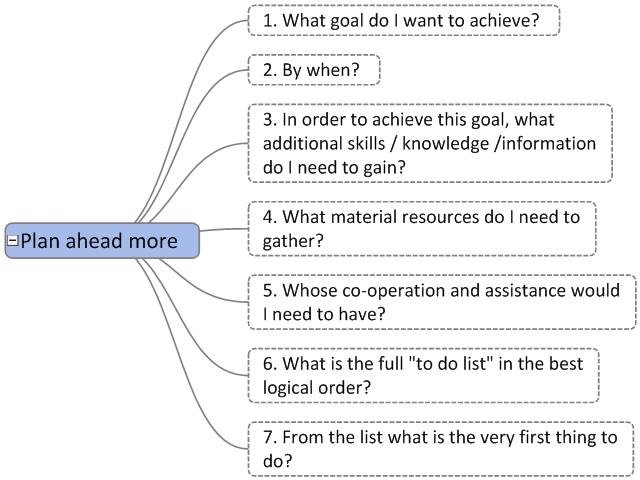
The best way to be a better planner is to learn the following set of questions and answer them in writing.
- What goal do I want (or need) to achieve?
- BY WHEN does this goal need to be achieved? Meaning: What is the deadline? How much time do I have?
- In order to achieve this goal, what mental tools do I need? Meaning; what additional skills or additional knowledge or additional information do I need to gain? From where can I find this information, skill or knowledge?
- In order to achieve the goal; what material resources do I need to gather? Meaning, what additional money, or new technology, or documentation and authorities do I need to have?
- In order to achieve the goal; whose co-operation and assistance would I need (or like) to have: and how can I gain this person's cooperation?
- With the above information in mind, then what is the complete list of activities that I need to do? What is the full "to do list" of items written in the best logical order?
- From the list mentioned above, what is the very first thing to do? When do I need to start?
Achieve more with less effort
If you were to get into the habit of thinking about these 7 questions, and especially if you were to get into the habit of writing the answers down on paper, then you would find that your ability to plan ahead and to avoid problems and achieve more with less effort, would radically improve.
And if you were to memorise the 7 questions and start to ask the other people you work with the same questions, you would find that they would make fewer errors, and would not mess up so often.
You would have fewer things to put right and things would go better for you and the others too.
So why not memorise the questions and start practicing the art of planning ahead more.
Plan ahead in writing and you will be amazed at how much time, money and effort you save.
[time Banner]
Planning ahead
In business, planning ahead is a process that fixes a clear goal, lists every task and needed resource, sets time limits and priorities, and forecasts problems while arranging help. If any one of these parts is missing, you are not truly planning ahead; you are only reacting to events as they happen.
CG4D Definition
Context: Business
Genus: Process
- Fixes a clear goal to reach
- Writes every task and needed resource
- Sets time limits and order of work
- Looks ahead for risks and gains support
Article Summary
Planning ahead links clear goals to daily action. When you write a plan and answer seven key questions, you spot what you need, set a deadline, win help and list each step. This approach cuts errors, saves time and lifts your results; it turns wishful thought into steady progress and stronger time management.