






How To Prioritise Tasks Effectively
There are two groups of people who need to know how to prioritise: Those who want to achieve their highest levels of productivity, and those who feel overwhelmed by the sheer volume of their work.
Those who want to achieve more productivity need to prioritise because, not all tasks have equal value, and those interested in making progress, need to focus their efforts onto those tasks that add the most value.
In addition, everyone is "a limited resource, facing an unlimited demand". It is impossible to do everything, so we should abandon the attempt and instead, learn to prioritise.
Managers may also find this practical guide useful: time management techniques for managers.
Prioritisation is the art of putting things into the right order.
It can be done by means of two methods:
- Prioritisation by reference to Value and Deadline pressure.
- Prioritisation by reference to Logical sequence.
Let us look at each method in turn:
1. Prioritisation by reference to value and deadline pressure.
Each task may be judged according to two fundamental criteria, its Value (high to low) and its Deadline Pressure (high to low). These two criteria can be used as the basis of a model that produces four categories of work. Please study the grid below.
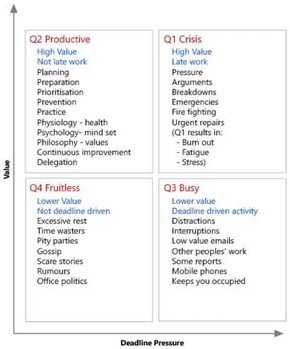
Tasks should be done in order that approximates to the numbering on the grid, that is:
Q1 Crisis, emergency, "all-hands-on-deck" activity, must take precedence over...
Q2 Long-range, high value, Productive, preventative activity, which should take precedence over...
Q3 Lower value, "busy but non-productive" work, which takes precedence over...
Q4 Lower value, fruitless or waste of time activity.
We should spend the majority of time in Q2 activity: The High Value, but NOT YET late, category of work, which includes, planning, preparation, practice, prevention, problem solving activities.
Failure to do Q2 prevention, preparation, and planning creates the conditions for next month's batch of Q1 Crises.
Beware the Q3 Busy Zone: The most common mistake is that people spend too much time in the "Q3 Busy but non-productive Zone", which denotes all the time people spend working hard, on trivial things that don't add much value, nor get them closer to their goals.
This is the most common error, and most people make it every day.
The solution is to limit time spent in Q3 busy work: Minimize the time spent in "Q3 busy zone" and transfer it over to "Q2 Productive zone" which is defined as, "High value, long range, preventative activity".
What is the most valuable use of my time, right now?
The key concept is VALUE. If we want to succeed, then every day, we must do the most valuable things: NOT the easiest things, not the most pleasant things, but rather, the most valuable things.
How can we determine what is the most valuable thing?
We have created a Prioritisation APP which you can use, to determine the most valuable use of your time. Please follow this link to gain access to the prioritisation APP.
2. Prioritisation by reference to logical sequence.
The second method of prioritisation is by reference to "logical sequence".
Every task is composed of a larger number of subset tasks, which should be done in their most logical sequence. Every task has an ideal, most efficient sequence which if followed, would be the optimum sequence and therefore, the most productive.
Even simple tasks, such as getting dressed in the morning has a definite sequence; you always put your socks on before your shoes, you always put your shirt on before your jacket.
It is not enough to do the right things; we must also do them in the right order.
If you mess up the logical sequence of any task, then the tasks become inefficient or it fails completely.
In order to organise sequencing, then ask and answer the following question:
Which of these tasks, should logically come first?
Keep asking yourself questions about logical sequencing, which is sometime called, "Critical path analysis" and try to get the sequencing logically right.
Combining methods of prioritisation.
Whenever you are prioritising tasks, there are three questions to consider:
- Which tasks are the most valuable?
- Which have the greatest deadline pressure?
- Which tasks logically MUST be done, before the other tasks CAN be done?
Value-Deadline Matrix
The Value-Deadline Matrix is a simple time-management model. It places each task on a four-box grid by judging its value to the goal and the time left before the deadline. This view shows which tasks are crises, which are high-value early work, which are low-value chores and which are waste, so you act in the best order.
CG4D Definition
Context: Business time management
Genus: Decision-making model
- Rates every task on two factors: value and deadline pressure.
- Forms four quadrants (q1–q4) that set clear priority order.
- Guides focus to high-value, not-yet-urgent work after crises are handled.
- Flags low-value busy or waste tasks for delay or removal.
Article Summary
To master time, stop trying to do it all. Judge each job by value and deadline, act first on high-value items before they turn urgent, and set the steps in the right order. By moving hours from low-value busy work to planned Q2 tasks, you gain calm, speed and real results.