







How to Create SMART Goals
Definition: SMART Goals are a structured method for setting goals and planning for their achievement.
The acronym SMART stands for Specific, Measurable, Achievable, Realistic, Time-limited.
In more detail, the SMART model is expanded to become 8 SMART questions, which may be visualised like this:
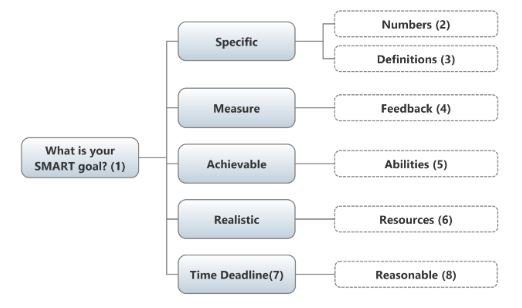
8 Part SMART
The SMART goals model suggests eight SMART questions.
If you want to set SMART goals, ask these eight questions of yourself and others. The answers reveal all the information needed to specify goals and build practical plans for their achievement.
1. In general terms, what is the goal to be achieved?
State your goal in a single sentence, affirming what it is you want to achieve.
2. How is the goal specified numerically?
Take the original statement and specify it by quantifying the goal objectively, using numbers.
3. How is the goal specified in words?
Take any ambiguous term from the general statement and define its exact meaning.
4. To measure progress, what feedback measures need to be tracked?
In order to track your progress towards the goal, you need to pick a few key performance indicators, which you will record, and use as feedback.
5. What intellectual abilities are needed - skills, knowledge, experience and information?
In order to achieve the goal, you will almost certainly have to increase your knowledge and skills. Where will you gain this increase in knowledge.
6. What physical resources; money, technology and people are needed?
In order to achieve your goal, you will need additional resources. By what means will you gather these resources? Whose help do you need. You need to make a list of the people whose help you will need to gain.
7. What is the time deadline?
You need to decide by when you intend to achieve the goal. A goal with no deadline becomes almost meaningless. You need to give a sense of urgency to the goal, by naming the date by which it should be completed.
8. Is the deadline reasonable?
The goal needs to be reasonable. Not over-optimistic. Decide the deadline by making a logical evaluation of all the available evidence. The deadline is not a guess, and it is not a wish. It is a reasonable estimate. Name the date.
What is the Plan?
Look at all the information you have gathered by answering the preceding questions and write a detailed written plan. Then start immediately to put the plan into action.
Every goal needs a plan which is capable of achieving it.
Goal setting becomes especially powerful when the goal is converted into priorities, planned actions and protected time. Our time management training teaches the same eight-part SMART method alongside practical planning, prioritisation and delegation.
A goal without a corresponding practical plan is merely a delusion.
A goal tied to a practical plan is a powerful force for progressive change.
Free Tool to Create SMART Goals
Use our FREE tool to create your SMART Goals.
Goal Setting Training
This one-day Goal Setting Training Course will equip you with the skills that will enable you to set and achieve specific goals.
Aristotle: "First, have a definite, clear, practical goal. Second, have the necessary means to achieve your ends; wisdom, money, materials, and methods. Third, adjust all your means to that end."
SMART goal
In business, a SMART goal is a clear target that names one outcome, gives a number you can track, can be reached with the means you have, and sets a firm date to finish. If any point is missing, the target is not SMART.
CG4D Definition
Context: Business
Genus: Method
- States one clear outcome
- Includes a number you can track
- Can be reached with present means
- Sets a firm end date
Article Summary
SMART goals change loose wishes into clear, timed tasks. Ask the eight SMART questions, add numbers, set a fair date, list skills and kit, write the plan and act. When aims are specific, measured and dated, you guide progress and hit real results.