







Eight Part SMART Targets
You are probably aware of the five part SMART goals setting model, which states you should ensure your goals are:
- Specific.
- Measurable.
- Achievable.
- Realistic.
- Time bound.
Most people reduce SMART goals to a theory that they don't apply in practice.
In this form, the SMART model is too abstract to be of any practical use. To make it practical, you need to make a few additions to it.
Develop it into a series of eight questions and change its name to 8 Part SMART.
This diagram shows how the 8 Part SMART works:
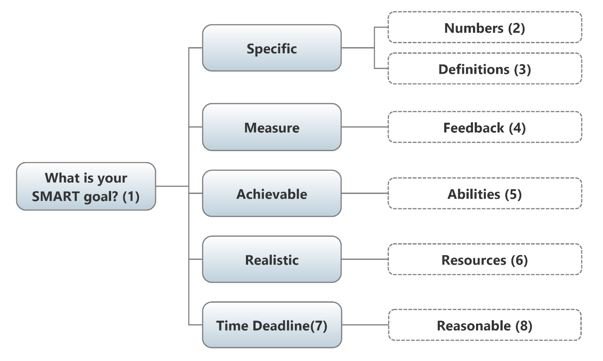
The SMART Goals model suggests 8 SMART questions.
Ask these 8 questions of yourself and others. They are all derived from the SMART method.
- In general terms, what is the goal you want to achieve?
- How would you specify that goal numerically?
- How would you specify and define all your key terms?
- What feedback measures would you need to track?
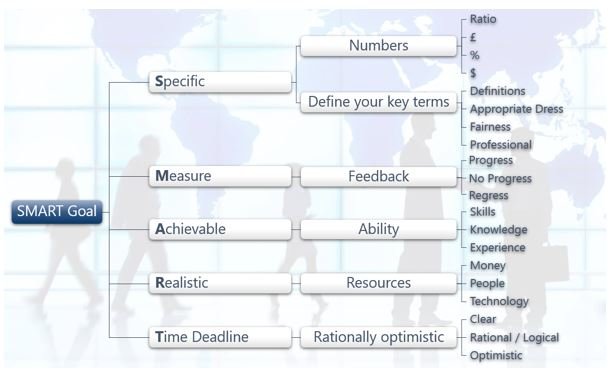
- What additional abilities; skills, knowledge and experience, do you need to gain?
- What resources; money, technology and people, do you need?
- What is the time deadline?
- And is that deadline reasonable or not?
SMART targets give you clarity
The first and most important ability for you to master is "Clarity of purpose".
You need to decide exactly what you want; and you need to discover exactly what the other person wants.
Only then can you create a mutually beneficial relationship - do business - with each other.
Purpose statement
A purpose statement is a written document that identifies the goals and the plans that will deliver them. The SMART goal identifies the "target to be hit".
You can use the 8 SMART questions in three different ways:
- To set your own goals, for a better future.
- To help others to set their goals.
- To set, communicate and plan for team goals.
Ultimately, the 8 Part SMART model looks like this:
Goal Setting Training
Our Goal Setting, Communication and Conflict Training Course is ideal for those people wishing to improve their performance and achieve their goals.
8 Part SMART model
In business goal-setting, the 8 Part SMART model is a method that turns a wish into an action plan by asking eight short questions. It names the goal, sets a number, defines terms, picks feedback, lists needed skills, lists resources, sets a deadline and checks if the time is fair. If any of these eight steps are left out, the model is not used.
CG4D Definition
Context: Business
Genus: Method
- Uses eight questions to frame every goal
- Ties each question to the smart idea of clear, numeric and timed targets
- Requires measure, skills, resources and deadline to be named
- Works for personal, team and business aims
Article Summary
The 8 Part SMART model replaces abstract theory with eight simple questions that define the goal, nail the numbers, secure resources, set a fair deadline and give you and your team the clarity to hit every target.