




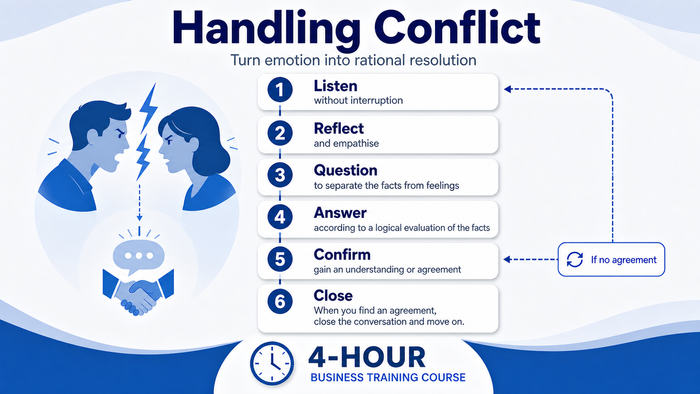
From emotion to rational resolution
Handling Conflict and Difficult Conversations: Follow On Training 4 hours
This four-hour follow-on session covers the conflict management method, objective language, and future-focused resolution. Delegates learn to move difficult conversations away from emotion, accusation, and blame towards facts and practical action. They leave with a personal action plan ready to apply on returning to work.
Available as live online training via Microsoft Teams, or as bespoke in-house training tailored to your organisation.
Course Overview
Handling conflict and difficult conversations
This four-hour follow-on course is designed for delegates who have already developed a grounding in conflict management through the Conflict Management Training programme or the Leadership and Management Training two-day course, and who want to deepen their practical ability to handle difficult conversations in real situations. Where the full-day course covers the complete breadth of conflict prevention and resolution theory, this session focuses on applied practice: working through the six-step conflict management method, rehearsing the language that works, and leaving with a clear personal approach to any difficult conversation that arises on returning to work.
Wherever people work together, some conflict is inevitable. The important question is not whether conflict will happen but whether people know how to handle it in a calm, professional, and rational way. Delegates learn to replace the impulse to avoid the issue, react in the heat of the moment, or accept an unacceptable situation passively, and to adopt instead a structured, rational approach grounded in facts, evidence, and clear thinking. The course examines each of these three failure modes in turn and provides a practical alternative for each.
The session also addresses the specific challenge of resolving conflicts between other parties: situations where the conflict manager was not present at the original incident and must act fairly without complete knowledge of the facts. Delegates who manage people dealing with interpersonal friction, or who regularly support colleagues through disputes, will find this section directly applicable.
Core Skills
The Key Skills Covered
This course focuses on the fourth of the six essential leadership skills: conflict management and handling difficult conversations. Each section provides a practical method that delegates can apply immediately on returning to work.
-
1
Using Reason in Conflict
Three unhelpful patterns emerge when conflict arises: avoidance, emotional outburst, and passive acceptance. Each one makes the underlying problem harder to resolve. This skill identifies all three and introduces the rational alternative: staying in the conversation, controlling the language used, and keeping the focus on facts. Rational does not mean cold or detached; it means choosing responses that move the conversation towards a practical outcome rather than away from one.
-
2
Objective, Factual Language
The language selected in a conflict conversation signals whether the speaker seeks resolution or escalation. Phrases built on accusation, personal opinion, or emotional interpretation invite a defensive response and close dialogue down. Objective language, anchored in specific and observable facts, invites engagement and keeps the conversation productive. Delegates practise restating charged messages in factual terms and observe the immediate difference in how those messages are received.
-
3
Behaviour, Not Character
Attacking a person's character shuts down productive conversation and triggers defensiveness. Effective conflict management focuses exclusively on the specific behaviour in question: what was done or said, when it happened, and what the effect was. This approach addresses the problem directly while protecting the other person's self-concept, making genuine behavioural change far more likely. Delegates practise framing concerns as specific observations rather than personal verdicts.
-
4
The Six-Step Method
A structured method removes the guesswork from difficult conversations. The six steps provide a clear sequence from opening the conversation through to gaining a specific commitment to change. Each step has a defined purpose, and knowing where you are in the sequence prevents the conversation from drifting into circular argument or unresolvable dispute. Delegates apply the method to a real scenario from their own working context and adapt it before they leave.
-
5
Future-Focused Resolution
Conflict conversations that stay anchored in the past almost always fail to reach resolution. Both parties hold their own version of events, and neither version can be fully verified. This skill introduces the discipline of forward-focus: redirecting the conversation from what went wrong to what will be different going forward, so that the discussion moves towards practical outcomes rather than competing accounts of the past.
-
6
Voice Tone and Body Language
Non-verbal signals communicate emotional state as effectively as words. A calm, measured voice and composed body language project rational authority and genuine intent to resolve the issue. A raised voice, tense posture, or avoidant eye contact signals that the conflict has become personal rather than professional. Delegates review the specific adjustments to voice tone, pace, posture, and proximity that make their message more credible and their presence more composed under pressure.
Who Is This Course For?
Who Should Attend This Follow On: Handling Conflict and Difficult Conversations Course?
Designed for delegates who have a grounding in conflict management and want to develop a deeper, more applied capability in handling difficult conversations using the six-step method.
Leadership and Management Graduates
Deepen your conflict management capability after completing the two-day programme.
Team Leaders and Managers
Handle difficult conversations with team members confidently and move disputes to practical resolution.
Supervisors and Team Members
Build a reliable, structured approach to conflict before it becomes a source of personal stress.
Anyone Seeking Greater Confidence
Develop the composure, language, and method to handle any difficult conversation professionally.
Also valuable for HR and people professionals who support colleagues through workplace disputes, and for supervisors and team members who want a focused, practical method for managing difficult conversations without first attending the full-day course.
Course Agenda
Follow On: Handling Conflict and Difficult Conversations Course Details
Part One • Handling Conflict with Reason and Objectivity • Rational thinking, objective language, and behaviour-focused communication
Understand the three unhelpful responses to conflict and why each makes the situation worse, learn to replace emotionalised language with factual, objective alternatives, and develop the discipline of commenting only on behaviour rather than character.
Part Two • The Six-Step Method and Difficult Conversations • Structured resolution, third-party conflicts, and action planning
Apply the six-step conflict management method to real workplace scenarios, learn how to resolve conflicts between other parties when you were not present at the original incident, and practise redirecting conversations from past blame to future solutions using controlled voice tones and body language.
Availability and Pricing
Course Formats and Delivery Options
Choose from scheduled open follow on: handling conflict and difficult conversations courses, live online training or bespoke in-house follow on: handling conflict and difficult conversations training for your organisation. Each format covers the same practical methods and learning outcomes.
Online Live Training
£200 +VAT
per delegate
Interactive live sessions delivered via Teams using our superior green-screen technology.
- Same content as face-to-face
- Learn from home or office
- Delivered via MS Teams
- Laptop or tablet with webcam
Bespoke In-House
Enquire
per training day
We come to you. Training delivered at your premises, tailored to your team's specific needs.
- Your premises or online
- Tailored to your organisation
- Dates to suit your schedule
- We can train in your timezone
All Our Training Includes
Questions? Call 020 3856 3037 or 01452 856091
Upcoming Dates
Next Available Course Dates
No upcoming dates are currently listed.
Please get in touch to enquire about availability.
Please get in touch to enquire about availability.
Frequently Asked Questions
Course FAQs
Have a question that is not answered here?
Book This Course
Questions? Call us on
020 3856 3037Trusted by Leading Organisations
Companies We Have Trained
"I found the course very informative. It helped me recap on management degree. Highly recommend course. The trainer was very knowledgeable on the subject area. Great pace of training and gave opportunities to raise or discuss areas we wanted too. Strong, knowledgeable trainer. "
Kim McCready
Taurus Healthcare
"The course provided clear and logical methodologies and best practices in order to focus efforts for the best results. Also provided reassurance on several areas that I already put into practice with supplementary notes. The trainer was clear and directed with a good pace. Good use of examples to explain different areas."
Michael Stevens
Production Plus
"The course content was very detailed and relevant to the workplace. I found it all very valuable, especially the distinction of objective and subjective. The trainer's presentation was captivating, really engaging, informative and interpersonal. Giving feedback and interaction was relaxed and the course setting put me at ease."
Lois Robinson
Places for People
Related Reading
-
Grievances at Work: How Managers Should Respond
Learn how to handle a grievance at work fairly with the FACTS method: define the complaint, gather evidence, hear all sides and decide fair next steps.
-
Do We Focus Too Much on Our Differences at Work?
Do we focus too much on our differences at work? Learn how clarity, rationality and positivity help managers build unity, teamwork and better communication.
-
Fixing Bad Relationships at Work
Struggling with conflict? Fixing workplace relationships needs clarity, rationality and positivity. Use calm language, drop verbal anger and rebuild trust.
Ready to Handle Conflict and Difficult Conversations with Confidence?
Book this four-hour follow-on session for yourself or your team, and leave with a clear method, sharper language skills, and the confidence to handle any difficult conversation professionally.
Or speak to a member of our team directly: