







Inspirational Leadership
There are many ways to motivate others, but not all forms of motivation are inspirational.
- It is possible to motivate people by inducing fear. But motivation by fear is not very inspirational.
- It is possible to motivate people by inducing anger. But motivation by anger, is not very inspirational
- It is possible to motivate people by inducing a passion; enthusing people with a burning desire build a better future. Motivation by means of enthusing people with optimistic visions of a better future is the method inspirational leaders prefer.
There are many people in modern society who are attempting to motivate people by means of anger and fear. To a degree, these methods do work, but they are destructive to the individual and to the wider society, and we don't recommend them.
Everything you say affects the emotions of others.
It is important to remember that everything you say affects the emotions of others.
Everything you say will either:
- Tend to inspire positive emotions in the minds of others, or
- Fail to inspire positive emotions, or
- Inspire negative emotions.
Develop the art of conversation control.
As a leader, it is important to purposefully cultivate an acute awareness of the emotional consequences of your use of language. Your aim is to ensure that the lions share of what you say, is purposefully geared towards inspiring positive emotions in the minds of others.
The positive emotions we mean are: Optimism, passion, courage, persistence and reason.
At the same time, it is important to cautiously regulate the amount of time spent in saying things that may (accidentally or carelessly) induce the emotions of fear, anxiety, anger or upset.
Here is how various categories of speech affect the emotions.
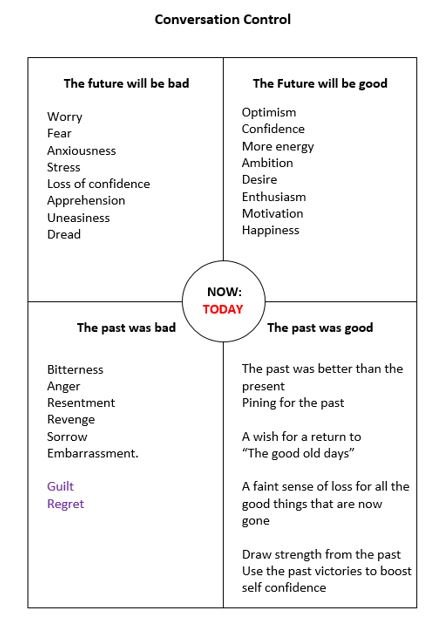
Inspirational leaders are often great speakers.
There is a strong correlation that connects inspirational leadership with great speakers. If you were to list all the inspirational leaders of history and science, and then compile a list of all the great speakers, you would find the two lists contain the same names.
For example:
John F Kennedy: "We choose to go to the Moon in this decade and do the other things, not because they are easy, but because they are hard, because that goal will serve to organise and measure the best of our energies and skills..."
Michael Faraday: "Nothing is too wonderful to be true, if it be consistent with the laws of nature."
Florence Nightingale: "How very little can be done, under the spirit of fear. Live life. Life is a splendid gift."
Marie Curie: "You cannot hope to build a better world without improving the individuals. To that end, each of us must work for our own improvement."
Become a positive role model.
As we have discussed, your use of language can have a powerful effect on the emotions and lives of others.
But your actions are even more powerful.
The way you act and react to failure and success will affect the emotions of others around you.
If you conduct yourself always with courage, optimism, reason and compassion, then your example will serve as a beacon for others to follow.
Becoming a role model means that you hold yourself to the highest standard of personal performance and etiquette; and you do that every day, even on the days you don't feel like it. Even during the tough times.
Especially during the tough times.
Leaders do not need the environment to inspire them.
Leaders inspire themselves by taking control of their thoughts, feelings, actions and reactions and directing them all towards visions of a better, more optimistic future.
Take the Inspirational Leadership Challenge.
I ask you to take these two issues seriously:
- Everything you say and
- Everything you do
Ensure that your words and actions are purposefully geared to move people away from emotions of fear, anxiety or anger.
Commit to purposefully and consciously talking and acting in ways that are likely to trigger positive emotional responses in the minds of others.
This is the challenge of inspirational leadership.
Inspirational leadership
In business, inspirational leadership is a leadership style where the leader lifts team spirit through hopeful vision, clear positive speech, steady role-model actions and strong self-control. The leader paints a better future, speaks to courage not fear, shows the behaviour expected from others and keeps their own mind set on optimism.
CG4D Definition
Context: Business
Genus: Leadership style
- Gives a clear, hopeful picture of a better future
- Uses positive, uplifting words, never fear or anger
- Shows daily courage, fairness and reason through action
- Holds steady self-control of thoughts, feelings and deeds
Article Summary
Inspirational leadership moves people by painting a hopeful picture of the future and using clear, positive words that spark courage and steady action. Studies show teams led in this way feel safe and achieve more, while fear-based talk drains drive. Choose to make every word and deed lift minds from anger or worry towards shared purpose, and you become the role model who turns hope into daily results.