
Corporate Coach Group Logo
Corporate
Coach Group

Applied planning and prioritisation training

Time Management, Planning and Prioritisation: Follow On Training 4 hours

Poor time management, poor planning, and poor prioritisation are among the most common causes of workplace underperformance. People frequently have goals but do not translate those goals into written plans, projects, and schedules, and the result is that they stay busy but not genuinely productive.

Available as live online training via Microsoft Teams, or as bespoke in-house training tailored to your organisation.

Quality Training
Established 1997
4 CPD Hours

Course Overview

Time management, planning and prioritisation

The course introduces a four-stage organising method: turn the goal into a written plan, divide the plan into projects, divide each project into tasks, and put each task onto a schedule. This sequence gives every delegate a clear track to run on: a structured, written path from where they are now to where they want to be. Without that structure, effort tends to scatter across reactive demands and low-priority work, while the most important tasks are repeatedly deferred. The discipline of organising before acting is one of the simplest and most consistently effective ways to improve personal output.

Alongside the planning method, delegates learn to prioritise work using three simultaneous factors: business value, deadline pressure, and logical task sequence. This three-factor approach is more robust than single-axis prioritisation because it accounts for tasks that are important but not yet urgent, tasks that depend logically on the completion of others, and tasks that feel pressing but contribute little to the goal. Delegates also learn how to use five minutes at the start of a session to determine the most productive use of the next six hours: a habit that consistently outperforms reactive, event-led working.

This follow-on session assumes familiarity with the six-skill leadership framework introduced in the Leadership and Management Training programme and focuses specifically on the planning and prioritisation skills that delegates most often find hardest to embed in practice: building written plans, maintaining them under pressure, and avoiding the traps of drifting, procrastination, and spreading effort too thinly.
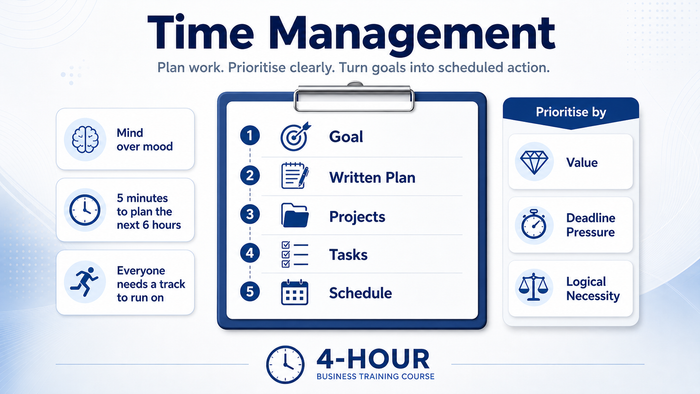
Time Management diagram showing the five-stage hierarchy: 1 Goal, 2 Written Plan, 3 Projects, 4 Tasks, 5 Schedule. Left panel shows three principles: Mind over mood; 5 minutes to plan the next 6 hours; Everyone needs a track to run on. Right panel shows Prioritise by: Value, Deadline Pressure, Logical Necessity.

Core Skills

The Key Skills Covered

This course focuses on the third of the six essential leadership skills: time management, planning, and prioritisation. Each section provides a practical method that delegates can apply immediately on returning to work.

  1. 1

    The Four-Stage Organising Method

    Goals without plans remain aspirations. Plans without projects become unmanageable. Projects without tasks lack clear action steps. And tasks without schedules never get started. The four-stage method links each level of the work hierarchy in a logical sequence, ensuring that every goal is backed by a concrete, actionable, and dated programme of work. Delegates apply the method to a real goal from their own role during the session.

  2. 2

    The Five-Minute Daily Plan

    Most people begin their day by opening email or reacting to whatever arrives first. The five-minute daily plan replaces that reactive start with a brief, deliberate act of organising: reviewing the schedule, confirming priorities, and identifying the single most important task to complete before anything else. Applied consistently, this five-minute investment saves multiple hours of misdirected effort each week.

  3. 3

    Three-Factor Prioritisation

    Effective prioritisation requires evaluating each task against three criteria simultaneously: how much value does it contribute, how pressing is its deadline, and what other tasks must be completed before it can proceed? Applying all three criteria produces a priority list that survives the pressures of a working day, because it accounts for dependency chains and future urgency, not just what feels most pressing right now.

  4. 4

    Overcoming Procrastination and Drift

    Procrastination rarely looks like idleness. It tends to disguise itself as busy work: responding to emails, attending unnecessary meetings, or clearing the desk before starting the real task. Drift is subtler still, the gradual slide from a clear plan into reactive, unplanned activity over hours or days. This section identifies the early warning signs of both patterns and provides specific techniques for interrupting them before they consume significant portions of the working day.

  5. 5

    Busy Work vs Productive Work

    A person can be busy for an entire day while producing little that advances their most important goals. The distinction between busy work and productive work is not about effort; it is about direction. This section gives delegates a practical method for assessing their own daily task mix, identifying the activities that produce genuine results versus those that create the illusion of progress, and gradually shifting time and attention towards the work that matters most.

  6. 6

    Written Plans as a Daily Control Tool

    A plan that exists only in someone's head is not a plan; it is a wish. Written plans serve as a daily control mechanism: they make commitments visible, create accountability, reduce the mental load of trying to hold everything in memory, and provide a clear reference point when priorities need to be reviewed. This section covers how to write plans that are genuinely useful rather than bureaucratic, and how to keep them current without creating more work than they save.

Who Is This Course For?

Who Should Attend This Follow On: Time Management, Planning and Prioritisation Course?

Designed for delegates who have completed the two-day Leadership and Management Training course and want to develop a deeper, more applied capability in time management, planning, and prioritisation.

Leadership and Management Graduates

Deepen your time management capability after completing the two-day programme.

Managers and Team Leaders

Build a structured, plan-led approach to managing workload and meeting deadlines.

Supervisors and Project Leads

Translate project goals into tasks and schedules that the whole team can follow.

Sales and Customer-Facing Teams

Manage competing demands, meet deadlines, and protect time for the highest-value work.

Also valuable for managers and team leaders who want a focused, practical session on planning and prioritisation without first attending the two-day course, and for HR and L&D professionals building a structured leadership development programme.

Course Agenda

Follow On: Time Management, Planning and Prioritisation Course Details

1

Part One • Planning and Organising Work • Goal definition, written plans, projects, tasks, and schedules

Learn how to organise any goal into a structured written plan by moving through the four stages of the hierarchy: plan, project, task, and schedule. Explore why rational, plan-led working consistently outperforms reactive, event-driven behaviour, and establish the habits that keep a written plan alive during a demanding working week.

Most time management failures are not caused by a lack of technique; they are caused by following feelings rather than plans. The emotion of the moment, the urge to check email, to finish an easier task first, or to avoid a difficult conversation, routinely overrides rational intention. We open by exploring why effective time management is fundamentally an act of intellectual discipline: committing to a plan and following it regardless of how you feel in the moment. This principle underpins every other technique covered in the session.
A goal that cannot be stated in a single, clear sentence is not yet a goal; it is a cluster of vague intentions. We cover how to compress the goal into one sentence that captures what success looks like, by when it must be achieved, and how it will be measured. This exercise forces the precision that most goal-setting processes skip. Delegates practise on a real goal from their own role and leave this section with a goal statement that can be communicated clearly to anyone.
Once the goal is defined, the next step is to identify every significant action required to achieve it, assign responsibility for each action, and record both in writing. The written plan becomes the single reference document that governs what gets done, by whom, and by when. We cover the difference between a genuinely useful plan and a bureaucratic one, how to keep the plan concise enough to use daily, and what to do when circumstances change and the plan needs to be revised without losing its discipline.
Most meaningful goals require more work than can be captured in a single list of tasks. Dividing the plan into projects, distinct workstreams each with their own objective, owners, and timeline, makes the work manageable and accountable. We cover how to identify the natural project groupings within any plan, how to set clear objectives for each project so that everyone knows what done looks like, and how to sequence projects logically so that later ones are not blocked by incomplete earlier work.
A project objective defines what needs to be achieved; tasks define the individual actions required to get there. Well-defined tasks are specific, assignable, and completable within a defined period. We cover how to break project objectives into discrete tasks at the right level of detail: specific enough to act on, but not so granular that the list becomes unmanageable. Delegates practise on one of their own live projects and leave this section with a set of tasks ready to be scheduled.
A task without a scheduled time is merely an intention. Scheduling means assigning each task to a specific day and time block in the calendar, alongside an honest assessment of how long it will take. We cover the common scheduling errors that cause plans to collapse: underestimating task duration, leaving no buffer for the unexpected, and scheduling fragile, high-concentration work at low-energy times of day. Delegates leave with a clear understanding of how to build a schedule that is ambitious but genuinely workable.
The phrase describes what every effective plan provides: a clear path from the current position to the goal, with every stage mapped out in advance. When people lack this structure, they tend to drift, switching between tasks, reacting to whatever is in front of them, and ending each day uncertain whether they have made genuine progress. This section reinforces the value of maintaining a written plan and using it as the daily operational reference rather than relying on memory or mood.
2

Part Two • Prioritisation, Scheduling, and Productive Action • Value-based prioritisation, avoiding procrastination, and making better use of time

Apply a three-factor prioritisation method to determine which tasks deserve attention first, learn the techniques that prevent drift and procrastination from derailing a well-made plan, and practise the five-minute daily planning routine that turns good intentions into consistent, productive action.

At the start of any work session, five minutes spent reviewing the schedule, confirming priorities, and identifying the first task to complete will consistently produce better results than diving immediately into whatever feels most pressing. We introduce a simple five-step routine: review the goal, check the plan, confirm the three highest-priority tasks for the session, clear the workspace of distractions, and begin. Applied at the start of each day or each major work block, this routine replaces reactive drifting with deliberate, plan-led productivity.
Single-axis prioritisation, ranking tasks by urgency alone or by importance alone, consistently produces a suboptimal result. Tasks that are important but not yet urgent tend to be repeatedly deferred until they become crises. Tasks that are logically dependent on others get started before their prerequisites are complete, creating rework. We introduce a three-factor framework that evaluates each task against business value, deadline proximity, and logical sequence simultaneously, producing a priority order that is both rational and robust under real working conditions.
Drifting is the gradual migration from a planned priority to whatever is easiest or most recently demanded. Procrastination is the deliberate postponement of a task that feels difficult, large, or uncertain, in favour of smaller, simpler, or more enjoyable work. Both patterns are self-reinforcing: the longer a high-priority task is deferred, the more anxiety it generates, which in turn makes it harder to start. We cover the specific triggers that cause each pattern, and practical techniques for interrupting both: starting with the hardest task first, working in timed blocks, and narrowing the decision to the single next action rather than the whole task.
Starting too many tasks simultaneously is one of the most reliably counterproductive habits in demanding work environments. Each partly-started task competes for attention, creates a residue of unfinished business, and reduces the quality of focus available to every other task. We cover how to set a firm limit on the number of active projects at any one time, how to decide which tasks to park without losing track of them, and how to communicate boundaries to colleagues when new demands conflict with existing commitments.
Busy work fills time and creates the impression of effort without advancing the goal. It tends to be reactive, low-risk, and immediately visible to others: answering emails, attending meetings, and completing routine tasks. Productive work is often harder, less immediately visible, and more likely to be postponed: thinking, planning, writing, making difficult decisions, and completing the tasks that move the most important goal forward. We provide a practical diagnostic that delegates can apply to their own current workload and use to identify where effort is being misdirected.
Written plans work as a control mechanism in three distinct ways. First, they make commitments visible to the planner and to others, creating accountability that memory-based plans cannot provide. Second, they reduce the cognitive overhead of holding a complex work programme in mind, freeing attention for the quality of execution rather than the anxiety of remembering. Third, they provide a reference point for reviewing progress, identifying slippage early, and making deliberate decisions about whether to adjust the plan or restore it. This section covers how to review and update a written plan without undermining its authority as the governing document for the work.
The session closes with a structured review of all the techniques covered and an individual action planning exercise. Each delegate identifies the single most significant planning or prioritisation change they will make immediately on returning to work, writes it as a specific task with a completion date, and records the measure they will use to confirm that it is working. The result is a clear, realistic first step that can be taken the following morning.

Availability and Pricing

Delivery Options

Choose the delivery format that best fits your schedule and team.

All options deliver the same high-quality content.

Online Live Training

£200 +VAT

per delegate

Interactive live sessions delivered via Teams using our superior green-screen technology.

  • Same content as face-to-face
  • Learn from home or office
  • Delivered via MS Teams
  • Laptop or tablet with webcam
View Online Dates

Bespoke In-House

Enquire

per training day

We come to you. Training delivered at your premises, tailored to your team's specific needs.

  • Your premises or online
  • Tailored to your organisation
  • Dates to suit your schedule
  • We can train in your timezone
Request Callback

All Our Training Includes

Full 4 hours of expert training delivered by an experienced trainer
CPD-endorsed course: 4 CPD training hours (plus 2-3 additional hours via post-course online learning)
Full digital interactive course notes
Official training certificate
Access to free additional training material via our post-course portal
3 months of free telephone coaching while you implement your learning

Questions? Call 020 3856 3037 or 01452 856091

Upcoming Dates

Next Available Course Dates

No upcoming dates are currently listed.
Please get in touch to enquire about availability.

Contact Us

Frequently Asked Questions

Course FAQs

You can book directly online via our course dates page, call us on 020 3856 3037, or make an enquiry and we will call you back. We accept payment by BACS, cheque or credit card. Once booked, you will receive a confirmation email with full joining instructions.
Yes. We can deliver this course exclusively for your team at your premises or online, on dates to suit you. Bespoke in-house training is priced per day rather than per delegate, making it cost-effective for groups of four or more. We can also tailor the content to address your organisation's specific challenges.
This course is designed as a follow-on to the two-day Leadership and Management Training programme and assumes familiarity with the six-skill leadership framework introduced there. However, the planning and prioritisation content is fully self-contained and is also suitable for delegates who have not attended the two-day course but want a focused, practical session on organising work and prioritising tasks effectively.
Planning is the process of deciding what needs to be done and in what sequence to achieve a goal: it produces a written record of tasks, responsibilities, and deadlines. Prioritisation is the process of deciding which of those tasks to work on first, given limited time and competing demands. Both are essential: a plan without prioritisation produces a list that is worked through in the wrong order; prioritisation without a plan produces a series of disconnected actions that never accumulate into a completed goal. This course develops both skills and shows how they work together.
The phrase describes what a written plan provides: a clear, structured path from the current position to the goal, with every stage mapped out in advance. Without that track, people tend to drift between tasks, react to whatever arrives, and make little sustained progress on their most important work. The course introduces the four-stage organising method, from goal to plan, plan to projects, projects to tasks, and tasks to schedule, as the practical means of building and maintaining that track.
Procrastination is addressed directly in the second half of the course. We examine the psychological mechanisms that cause tasks to be postponed, including avoidance of difficulty, uncertainty about how to start, and the short-term comfort of busy work, and provide specific techniques for interrupting each pattern. These include starting with the hardest task first, working in timed blocks, and reducing the decision to a single concrete next action rather than the full, overwhelming scope of the task.
Yes. The course is designed for delegates who are already familiar with basic time management concepts and want to deepen their practical capability. The focus is on application rather than introduction: building written plans that are actually used, embedding the five-minute daily planning routine as a genuine habit, and developing the discipline to maintain plan-led working under pressure. Delegates who already use some of these techniques typically find that the course helps them apply them more consistently and systematically.
Yes, the training is highly interactive. Sessions include group discussions, exercises, case studies and individual action planning. The trainer actively teaches expert content rather than simply facilitating discussion, so delegates leave with structured knowledge they can apply immediately. The style is engaging and practical throughout.

Have a question that is not answered here?

Trusted by Leading Organisations

Companies We Have Trained

Customer Reviews

What Delegates Say About This Course

★★★★★

"Excellent course content and delivery. I have learned some extremely useful skills which I can implement in my role and bring the best value to the company from contract negotiations. The presentation was flawless. Thank you Chris!"

Victorian Fletcher

Turbine Surface Technologies Ltd

★★★★★

"Very informative and well set out. I found the time keeping and productivity portion most helpful. Marco was very upbeat and kept the group working to the same goal. Very knowledgeable and happy to answer any queries we had."

Dennis Edwards

Flint House

★★★★★

"The course content was very comprehensive, with a number of interesting and actionable systems. Also plenty of suggestions for future and further reading. The trainer's presentation was enthusiastic and well delivered, very good and engaging and good time keeping. "

James Peate

Engaging Communities Staffordshire

Related Reading

  • Good Time Management is Stress Management

    Discover proven time management tips to reduce work stress, prioritise tasks and defeat procrastination so you work smarter, meet deadlines and feel calm daily.

  • What is the Action Priority Matrix?

    Learn how the Action Priority Matrix ranks tasks by impact and effort to secure quick wins, advance major projects, delegate chores and sharpen time management.

  • What is the Pomodoro Technique?

    Learn how the Pomodoro Technique uses 25-minute work cycles and five-minute breaks to lift focus, cut mistakes and boost work efficiency all day no burnout.

Ready to Work More Productively?

Book this four-hour follow-on session for your team, and leave with a structured plan, a clear prioritisation method, and the habits to maintain both.

Or speak to a member of our team directly: