





Return control to the rational mind
Emotional Intelligence and Resilience: Follow On Training 4 hours
This four-hour course introduces the three-brain model and the emotional survival sequence: fear, freeze, flight, fight. Delegates learn to recognise this sequence in everyday working life and interrupt it. By the end, delegates manage their emotions more effectively, think clearly under pressure, and perform with greater confidence.
Available as live online training via Microsoft Teams, or as bespoke in-house training tailored to your organisation.
Course Overview
Emotional intelligence and resilience: managing your own mind under pressure
Many people are aware that emotions can interfere with clear thinking, but far fewer know how to interrupt that interference once it has started. This four-hour follow-on course is the second of six specialist programmes designed for delegates who have completed the Leadership and Management Training two-day course and want to develop a deeper capability in each of the six essential leadership skill areas. This session focuses on the fifth skill: the ability to manage your own emotions so that the rational mind stays in control, even in difficult, stressful, or threatening situations.
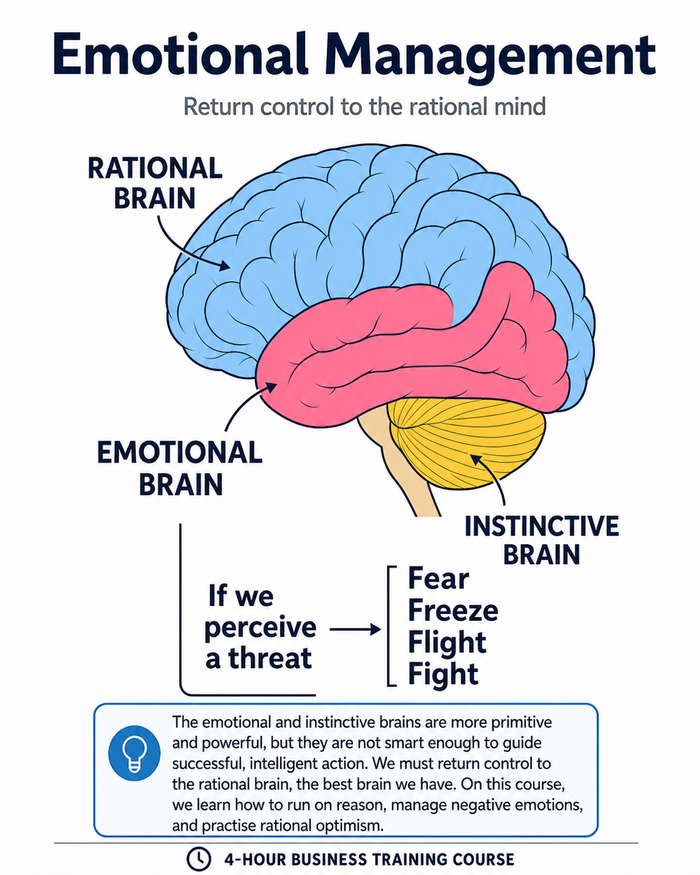
The course opens with the three-brain model: the rational mind, the emotional mind, and the instinctive mind. The rational mind is responsible for solving problems, making plans, setting goals, and making sound decisions; it is the part of the mind that produces success. The emotional and instinctive minds, however, react to perceived threat by triggering a four-stage survival sequence: fear, freeze, flight, fight. Once this sequence is running, the emotional and instinctive brains dominate, the rational mind is sidelined, and the ability to think clearly, plan, and act effectively is severely diminished.
The survival sequence appears in everyday working life in ways that are easy to miss if you do not know what you are looking for. Going blank in a meeting, avoiding a difficult conversation, procrastinating on a challenging task, reacting with anger to a stressful situation, or dropping into resignation and giving up: all of these are the survival sequence in action. Unlike Leading with Love, which examines how leaders can create emotional safety for the people they manage, this course turns the focus inward, giving delegates a practical method for recognising and interrupting their own emotional reactions before those reactions produce poor decisions or lost performance.
The course then introduces the nine problem-solving questions, known as the 9PSQs. These are a structured set of questions that redirect attention away from the perceived threat and back towards facts, goals, plans, resources, and the specific actions that will move the situation forward. Each question is designed to engage the rational mind and break the grip of the emotional sequence. The 9PSQs complement the goal-setting techniques covered in the Setting and Achieving Goals follow-on session, providing the emotional self-management foundation that makes sustained goal pursuit possible, even when conditions become difficult.
Core Skills
The Key Skills Covered
This course focuses on the fifth of the six essential leadership skills: the ability to manage your own emotions, maintain rational control, and build personal resilience under pressure. Each section provides a practical method that delegates can apply immediately on returning to work.
-
1
The Three-Brain Model
We explore in detail how the three-brain model governs behaviour under pressure. The rational mind is the seat of productive performance: it solves problems, makes plans, and drives progress. The emotional and instinctive minds are powerful but not wise under stress; they run automatic survival programmes that may have been useful for our ancestors but regularly undermine judgement and performance in professional settings.
-
2
The Four-Stage Survival Sequence
Fear, freeze, flight, fight: the survival sequence is triggered by perceived threat, not necessarily genuine danger. Once it is running, rational thinking is displaced and decision-making deteriorates. Delegates learn to identify the precise point at which the sequence begins in their own responses, and understand why the emotional brain can be activated by false alarms just as readily as real ones.
-
3
Recognising the Sequence in Real Life
Going blank, avoiding tasks, procrastinating, snapping at colleagues, and dropping into resignation are all manifestations of the survival sequence. Delegates examine each presentation in turn, identifying which stage they are most prone to and how the sequence shows up in their own specific behaviour and thought patterns. This self-knowledge is the first step towards genuine self-management.
-
4
Interrupting the Emotional Sequence
Once delegates can recognise the survival sequence as it appears in their own reactions, the next step is learning to interrupt it. The course covers a set of practical techniques for disrupting the emotional pattern and returning control to the rational mind, so that the response to a difficult situation becomes one of clear thought and purposeful action rather than reactive emotion.
-
5
The Nine Problem-Solving Questions
The nine problem-solving questions (9PSQs) are the primary tool taught on this course. Each question directs attention toward a specific area: the factual reality of the situation, the goal that still needs to be achieved, the plan for reaching it, the resources available, and the very next action that will move things forward. Working through the questions systematically disrupts the emotional sequence and re-engages the rational mind.
-
6
Building Personal Resilience
Resilience is not the absence of emotion; it is the ability to return quickly to rational thinking after emotional disturbance. Delegates learn how to apply the 9PSQs not only in acute high-pressure moments but as a regular self-management discipline, so that their default response to difficulty becomes rational problem-solving rather than emotional reaction. The result is a consistent, sustainable level of performance under pressure.
Who Is This Course For?
Who Should Attend This Follow On: Emotional Intelligence and Resilience Course?
Designed for anyone who wants to improve self-control, personal resilience, and rational thinking under conditions of stress, pressure, or self-doubt.
Leadership and Management Graduates
Deepen your emotional self-management capability after completing the two-day programme.
Professionals Under Pressure
Gain practical tools to think clearly, make sound decisions, and perform effectively even when circumstances are demanding.
Anyone Prone to Self-Doubt
Replace emotional reaction with a structured, rational response to the situations you find most challenging.
Individuals Seeking Greater Resilience
Build a lasting capacity to recover quickly from setbacks, pressure, and emotional disturbance.
Also valuable for team leaders and managers who want to develop their own emotional self-management alongside the people-leadership skills developed on the two-day programme, and for HR and L&D professionals building a blended personal development curriculum.
Course Agenda
Follow On: Emotional Intelligence and Resilience Course Details
First Half • Understanding the Mind Under Pressure • The three-brain model, the survival sequence, and how it appears in real life
Establish why the rational mind is the engine of all effective performance, explore the three-brain model in depth, and learn to recognise the four-stage survival sequence as it manifests in your own thinking, decisions, and everyday behaviour.
Second Half • Interrupting the Sequence and Applying the 9PSQs • Practical tools to reclaim rational control and build lasting personal resilience
Learn how to interrupt the emotional survival sequence at its earliest point, apply the nine problem-solving questions to redirect your mind from fear towards facts and planned action, and build the personal resilience to perform consistently under pressure.
Availability and Pricing
Course Formats and Delivery Options
Choose from scheduled open follow on: emotional intelligence and resilience courses, live online training or bespoke in-house follow on: emotional intelligence and resilience training for your organisation. Each format covers the same practical methods and learning outcomes.
Online Live Training
£200 +VAT
per delegate
Interactive live sessions delivered via Teams using our superior green-screen technology.
- Same content as face-to-face
- Learn from home or office
- Delivered via MS Teams
- Laptop or tablet with webcam
Bespoke In-House
Enquire
per training day
We come to you. Training delivered at your premises, tailored to your team's specific needs.
- Your premises or online
- Tailored to your organisation
- Dates to suit your schedule
- We can train in your timezone
All Our Training Includes
Questions? Call 020 3856 3037 or 01452 856091
Upcoming Dates
Next Available Course Dates
No upcoming dates are currently listed.
Please get in touch to enquire about availability.
Frequently Asked Questions
Course FAQs
Have a question that is not answered here?
Book This Course
Questions? Call us on
020 3856 3037Trusted by Leading Organisations
Companies We Have Trained
Customer Reviews
What Delegates Say About This Course
"Course content was excellent, good definitions and strategies to put in place, especially with a plan to follow. The trainer's presentation was very clear and informative, with good humour and approachable."
Jason Brentley
Heron Primary School
"The course content was easy to understand, interesting and covered a variety of important topics which were motivating and focused on self-awareness. The trainer was very good and explained all content very thoroughly and with enthusiasm."
Lucinda Croft
Thorpe House Nursing Home
"Excellent content and presentation. Factual, informative and helpful. This training will help greatly when dealing with various situations within the workplace. The training presentation was brilliant; well described, with great examples where necessary. Informative and helpful. Many thanks"
Mike Hodder
The Harmony Trust Ltd
Related Reading
-
Why Intelligent People Feel Anxious at Work
Learn why intelligent people feel anxious at work, how mental overload and unclear facts drive worry, and how clear thinking under pressure brings calm action.
-
Production and Trade
Learn how production and trade boost productivity, cut poverty and drive human progress. Our training shows simple steps to create value and earn more for all.
-
Solving Problems through Personal Initiative and Creativity
Learn how personal initiative and creativity let you solve problems, boost career success and turn ideas into value. Tips, stats and training links inside.
Ready to Manage Your Emotions and Think Clearly Under Pressure?
Book this four-hour follow-on session for yourself or your team, and leave with a practical set of tools to interrupt the emotional survival sequence and maintain rational performance in every difficult situation.
Or speak to a member of our team directly: