







Emotional Intelligence for Managers: A Practical Management Skill
Emotional intelligence is a practical management skill that helps people stay calm, think clearly, communicate well and lead others through pressure.
What is emotional intelligence in management?
Emotional intelligence in management is the ability to understand, regulate and influence emotions so that people move away from destructive emotional states and towards constructive action. It helps managers control their own reactions, support their team members, reduce conflict and keep attention focused on goals, facts, plans and solutions.
Managers need emotional intelligence in two directions. First, they need it towards themselves. They must be able to manage their own emotional state before they can help anyone else. Second, they need it towards other people. They must notice when a team member is anxious, frustrated, angry or discouraged, and respond in a way that improves the situation.
This is why emotional intelligence is a central part of good leadership and management training. Managers are not only judged by what they know. They are judged by how well they help other people think, speak and act under pressure.
Why managers need emotional intelligence
Every manager has to deal with pressure. Deadlines are missed. Customers complain. Team members disagree. Priorities change. Mistakes happen. In these moments, technical knowledge alone is not enough.
A manager's emotional state affects the emotional state of the team. If the manager becomes irritated, fearful or blaming, the team is likely to become more defensive and less effective. If the manager remains calm, clear and rational, the team is more likely to recover quickly and focus on the next useful action.
Emotional intelligence enables managers to respond rather than react. It helps them ask better questions, make better decisions and create a more productive working atmosphere.
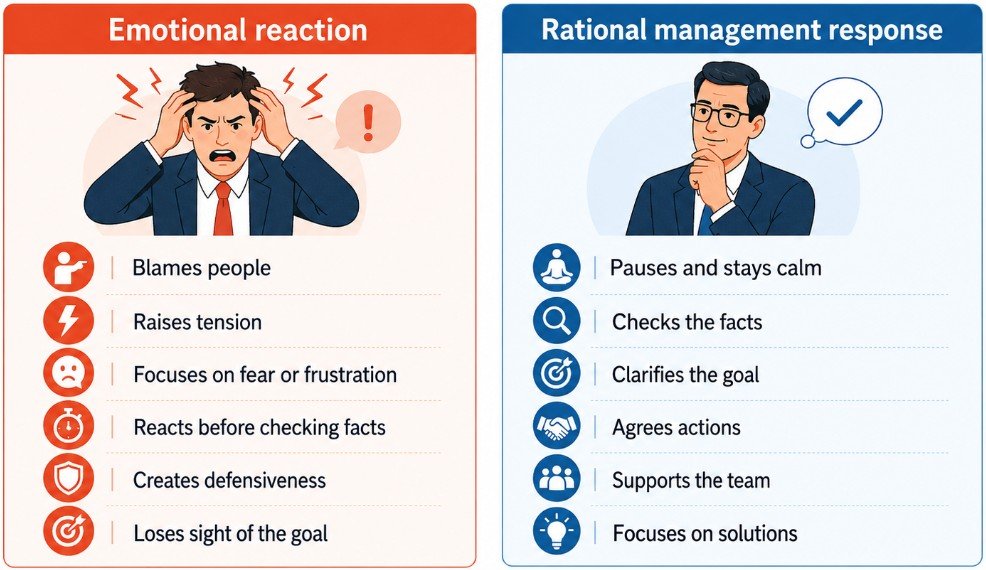
The rational mind and the emotional mind
Emotional management begins with a simple idea: every person has two competing systems operating inside one mind.
The first is the rational mind. The rational mind is logical, language-based, goal-focused and able to plan, solve problems and make decisions. It asks questions such as: What are the facts? What is the goal? What is the best plan? What should we do next?
The second is the emotional mind. The emotional mind is older, faster and more instinctive. It reacts to perceived threats, even when those threats exist mainly in imagination rather than reality. The emotions created by those perceptions are still real, even when the facts are incomplete.
When the emotional mind takes control, people tend to focus on fear, anger, anxiety, irritation, blame or upset. Attention moves away from goals and towards emotional reaction. When the rational mind takes control, people focus on evidence, causes, options, solutions and constructive action.
Emotional intelligence does not mean suppressing emotion or pretending that feelings do not matter. It means recognising emotions, accepting that they exist, then deliberately shifting attention back towards rational thought and useful action.
Example: emotional intelligence in a workplace problem
Imagine that a team has missed an important deadline. A manager with poor emotional control may immediately blame the team, raise their voice or assume that people were lazy or careless. This reaction may feel understandable, but it usually makes the situation worse. People become defensive, trust is reduced and attention moves away from solving the problem.
An emotionally intelligent manager handles the same problem differently. They first manage their own emotional response. They pause, lower the emotional temperature and ask rational questions. What exactly happened? What facts do we know? What caused the delay? What do we need to do now? Who needs help? What can we change so this does not happen again?
This approach does not excuse poor performance. It simply makes improvement more likely. Calm thinking produces better decisions than emotional reaction.
Nine questions emotionally intelligent managers ask
One of the best ways to regain control under pressure is to use structured questions. Questions direct attention. Poor questions keep people stuck in blame, fear and frustration. Better questions move people towards clarity, responsibility and action.
When a manager or team feels stuck, use these nine questions:
- What do we think we know, and how do we know it?
- What do we not know and need to find out?
- Based upon what we know, what is the best rational and optimistic goal?
- Who or what can help us achieve the goal?
- What resources do we need, such as time, tools, money, information or technology?
- What character traits do we need to embody, such as courage, consistency, fairness and teamwork?
- What is our best detailed written plan?
- Who is going to do what, and by when?
- What are our first three immediate actions?
These questions change the direction of thought. Instead of asking, "Who is to blame?" or "Why does this always happen?", the manager asks questions that create clarity and movement. To learn more about these questions, consider our management development training course.
This method is closely linked to effective problem solving skills, because both methods move people from emotional confusion into written plans and practical action.
Emotional intelligence and communication
Emotional intelligence also improves communication. Managers often need to say things that other people may not want to hear. They may need to correct poor performance, challenge bad behaviour, give feedback or explain an unpopular decision.
Without emotional intelligence, these conversations can become too harsh, too vague or too delayed. The manager may avoid the issue because they dislike confrontation, or they may handle the issue badly because they are annoyed.
An emotionally intelligent manager aims to be both clear and respectful. They separate the person from the behaviour, describe the facts, explain the impact and agree the next step. This is closely linked to clear, rational and positive communication.
Emotional intelligence and conflict
Conflict often becomes worse when people react emotionally before they understand the facts. One person feels attacked. Another feels ignored. Someone raises their voice. Someone else withdraws. The original problem is then buried under emotional reaction.
An emotionally intelligent manager does not inflame the conflict. They slow the conversation down. They ask people to describe facts, not insults. They focus attention on behaviour, impact and future action. They keep the conversation moving towards agreement.
This is why emotional intelligence is so useful when dealing with conflict situations. It helps managers stay calm enough to be fair, and clear enough to be firm.
How to develop emotional intelligence as a manager
Emotional intelligence can be developed through conscious practice. Managers can start by noticing their own emotional triggers. What situations cause irritation, anxiety or defensiveness? What thoughts appear in those moments? What actions usually follow?
The next step is to create a gap between feeling and action. A manager cannot always choose their first emotional response, but they can choose what they do next. They can pause, breathe, ask a rational question and choose a more constructive response.
Managers should also practise observing the emotional state of others. Is a person confused, worried, frustrated, embarrassed or defensive? The manager does not need to become a therapist. They simply need enough awareness to choose the right communication style.
For example, an anxious team member may need reassurance and structure. An angry person may need time to calm down before a useful conversation can happen. A discouraged person may need encouragement, clarity and a smaller first step.
These habits are also connected to self-control in leadership. A manager who cannot control their own reactions will struggle to lead others well.
Develop emotionally intelligent managers
Emotional intelligence is a practical management skill because it helps managers stay calm, think clearly and lead people towards productive action. It improves decision making, communication, conflict handling and team morale.
Corporate Coach Group's Leadership and Management Training Course helps managers develop the skills needed to lead people with confidence, clarity and emotional control.
Worked examples: emotional intelligence in management
Example 1: A team member reacts badly to feedback
A manager needs to speak to a team member whose recent work has fallen below the required standard. The manager is frustrated because the same issue has happened before. The team member is already defensive and may feel criticised.
A poor emotional response would be to start the conversation with blame: "You keep making the same mistakes." This may be true, but it is likely to make the person more defensive. The conversation then becomes emotional rather than useful.
An emotionally intelligent manager first controls their own tone. They focus on facts, not personal criticism. They might say: "I want to talk about the last two reports. Both were sent after the deadline and both needed corrections before they could be used. Let us look at what caused that and agree what needs to happen next."
The manager has not avoided the issue. They have made the issue clearer. By staying calm and specific, they make it easier for the team member to listen, respond and improve.
Example 2: Two colleagues are in conflict
Two colleagues disagree about how a customer problem was handled. One says the other did not pass on important information. The other says they were never asked. Both feel unfairly treated and the conversation is becoming personal.
A poor management response would be to take sides too quickly or allow the discussion to continue as an argument. Once people start defending themselves, they often stop listening.
An emotionally intelligent manager slows the conversation down. They might say: "Let us separate facts from interpretations. First, what happened? Second, what information was available at the time? Third, what do we need to do differently next time?"
This approach reduces blame and redirects attention towards evidence, learning and future action. The manager is not asking people to ignore their feelings. They are preventing those feelings from controlling the conversation.
Example 3: A manager feels overwhelmed by pressure
A manager is dealing with too many urgent tasks at once. A customer is chasing for an answer, a senior manager wants an update, and two team members need support. The manager feels anxious and starts jumping between tasks without finishing anything.
A poor emotional response would be to keep reacting to the loudest demand. This creates more stress because there is no clear order, no written plan and no sense of control.
An emotionally intelligent manager pauses and brings the rational mind back into control. They ask: "What do I know? What is most important? What can wait? Who can help? What are the first three actions?"
They may then write a short plan: first, send a holding reply to the customer; second, give the senior manager a clear update time; third, delegate one task to a capable team member. Within a few minutes, the manager has moved from emotional overload to rational action.
This is the practical value of emotional intelligence. It does not remove pressure, but it helps managers think clearly and act properly while pressure exists.
emotional intelligence in management
In leadership and management, emotional intelligence in management is a management skill that helps a manager notice feelings in themselves and others, keep their own reactions under control, guide strong feelings away from blame or fear, and move people towards facts, clear thought, fair talk and useful action under pressure.
CG4D Definition
Context: Leadership and management
Genus: Management skill
- The manager notices their own feelings and the feelings shown by others.
- The manager keeps their own tone, words and actions under control.
- The manager guides people away from blame, fear and anger.
- The manager moves the talk towards facts, clear thought, fair choices and useful next steps.
Article Summary
Emotional intelligence for managers is the skill of staying calm, reading the mood of others and moving people from emotional reaction to clear thought and useful action. It helps managers ask better questions, give fair feedback, handle conflict and protect team spirit under pressure.