







First Time Manager Guide: What to Do in Your First 90 Days
Direct answer: A new manager's first job is to set expectations, build trust, learn how the team's work is done and create clear standards for communication, performance and behaviour. In the first 90 days, do not try to change everything at once. Start by understanding the team, clarifying priorities, agreeing standards and dealing with issues early, fairly and calmly.
Becoming a manager for the first time is a major change. Yesterday, you may have been judged mainly by your own work. Today, you are judged by how well you help other people produce good work.
That shift can feel uncomfortable, especially if you have been promoted from within the same team. You may still want to be liked as a colleague, but you now have a duty to set direction, make decisions, delegate tasks, give feedback and hold people to agreed standards.
This first time manager guide gives you a practical structure for your first week, first month and first 90 days. Use it as a starting point to avoid common mistakes and build good management habits early.
The first principle: move from doing the work to managing the work
The biggest change for a new line manager is this: your value no longer comes only from being good at your own tasks. It also comes from helping the team work in a more organised, productive and co-operative way.
That means you must learn to think in terms of goals, roles, standards, systems, feedback and follow-up. These are the foundations of good line management.
A good new manager asks:
- What is the team expected to achieve?
- Who is responsible for which results?
- What standards must be met?
- What problems are slowing the team down?
- What decisions need to be made?
- What support does each person need?
- What behaviour should be encouraged or corrected?
These questions keep your attention on results, people and process. That is where line managers add value.
Your first week as a new manager
Your first week should be about listening, learning and creating calm clarity. Resist the urge to prove yourself by announcing major changes too quickly. People need to know what you stand for, but they also need to know that you understand the work before you start changing it.
In your first week, focus on these actions:
- Meet each team member individually. Ask about their role, current priorities, obstacles and ideas for improvement.
- Clarify your own manager's expectations. Ask what results matter most, what problems need attention and what success should look like in 90 days.
- Learn the work flow. Understand how tasks enter the team, how they are prioritised, who does what and where delays occur.
- Set a calm tone. Be friendly, but professional. Make it clear that you want a positive, fair and productive team.
- Avoid making promises too early. Listen carefully, then check facts before committing to changes.
Your aim in week one is not to have all the answers. Your aim is to build a clear picture of the team's current reality.
Useful questions to ask in the first week
| Question | Why it helps |
|---|---|
| What is working well at the moment? | Shows respect for existing strengths and avoids needless disruption. |
| What makes your job harder than it needs to be? | Identifies systems, communication and workload problems. |
| What should I understand about your role? | Helps you avoid false assumptions. |
| Where do you think the team needs clearer standards? | Reveals gaps in expectations, quality and behaviour. |
| What would make the next 90 days successful? | Encourages people to think about practical progress. |
Your first month as a new manager
By the end of the first month, you should move from observation to agreement. You are still learning, but now you should begin to set expectations, clarify priorities and create a reliable rhythm of communication.
The key task in month one is to answer this question: "What standards are we all working to?"
Standards should cover both work and behaviour. For example:
- What quality of work is expected?
- How quickly should tasks be completed?
- How should people communicate delays?
- How should disagreements be handled?
- When should problems be escalated?
- What does good teamwork look like?
Many new managers struggle because they assume standards are obvious. They rarely are. What seems obvious to one person may be vague to another. A manager's job is to make expectations clear enough that people know what good performance looks like.
Clear standards should also include workload, support and role clarity. The Health and Safety Executive explains these areas in its Management Standards for work-related stress.
Create a simple team operating standard
A useful first-month exercise is to create a simple team operating standard. This does not need to be a long document. A short, practical agreement is better.
| Area | Standard to agree | Example |
|---|---|---|
| Priorities | How urgent and important work is identified | We agree top priorities each Monday and review them each Friday. |
| Communication | How updates, delays and risks are shared | If a deadline is at risk, raise it early, not after it has failed. |
| Delegation | How tasks are assigned and checked | Every delegated task has an owner, outcome and deadline. |
| Feedback | How good work and poor work are discussed | Feedback should be specific, timely and linked to behaviour or results. |
| Behaviour | How people are expected to treat each other | Disagree with ideas respectfully, without personal remarks. |
This is where many new managers begin to feel the difference between being a colleague and being a line manager. You are no longer simply joining the team's habits. You are helping to shape them.
If you have been promoted from within the team, this can feel awkward. The article How do I manage my friends after a promotion? is a useful supporting read on that specific challenge.
Your first 90 days as a new manager
By the end of 90 days, you should have moved beyond first impressions. You should have a clear understanding of the team's work, people, strengths, risks and recurring problems. You should also have started to improve how the team operates.
Your main 90-day goal is to build a repeatable management rhythm. This rhythm should include:
- Regular one-to-one conversations.
- Clear team priorities.
- Delegated tasks with owners and deadlines.
- Timely feedback on performance and behaviour.
- Early action on problems.
- Simple ways to monitor progress.
Managers should also make time for regular one-to-one conversations. Acas recommends discussing progress through regular check-ins and reviewing objectives at agreed points. See the Acas guide to performance management.
Good line management is not about dramatic speeches. It is about consistent standards, clear communication and steady follow-up.
A practical 90-day model for first time managers
| Time period | Main focus | Practical actions | Outcome |
|---|---|---|---|
| First week | Listen and learn | Meet people, understand the work, clarify expectations with your manager. | You know the current situation before making changes. |
| First month | Clarify standards | Agree priorities, communication rules, delegation methods and behaviour standards. | The team knows what good work and good conduct look like. |
| First 90 days | Build rhythm | Run useful one-to-ones, give feedback, delegate properly, handle issues early. | The team becomes more organised, accountable and consistent. |
Common mistakes first time managers should avoid
Most first time managers do not fail because they lack effort. They struggle because they bring old habits into a new role. The following mistakes are common, but avoidable.
Trying to stay "one of the team"
You can still be friendly, respectful and approachable. But you cannot base your management style on being everyone's mate. If you avoid decisions because you want to be liked, standards will fall and resentment will grow.
Your aim should be fair authority. That means being warm with people, but clear about expectations.
Avoiding difficult conversations
New managers often delay difficult conversations because they fear conflict. The problem is that small issues rarely stay small. Poor timekeeping, careless work, negative behaviour and missed deadlines should be addressed early.
A useful rule is: correct behaviour while it is still easy to correct. Keep the conversation factual, calm and specific. Focus on what happened, why it matters and what needs to happen next.
For a practical feedback method, see The AID Feedback Model.
Failing to delegate
Many new managers keep too much work for themselves because they know they can do it quickly. This creates two problems. First, the manager becomes overloaded. Second, the team does not develop.
Delegation is not dumping unwanted tasks on others. It is the planned transfer of responsibility, with a clear outcome, deadline and level of authority.
For more detail, read Management Training: Delegation.
Giving unclear feedback
Feedback such as "be more professional", "improve your attitude" or "try harder" is too vague. People need to know which behaviour should continue, stop or change.
Clear feedback names the behaviour, explains the effect and states the required standard. For example: "When the report is sent after the deadline, the finance team cannot complete their review on time. From now on, I need the draft by Thursday at 3pm."
This is firm, fair and useful.
Workplace example: promoted from team member to manager
Imagine a new line manager called Alex. Alex has just been promoted to manage a team of six people. Two were close colleagues. One applied for the same role and did not get it. Another is experienced, but often misses internal deadlines.
In the first week, Alex meets everyone individually and asks about priorities, problems and suggestions. Alex also meets their own manager to agree the three most important outcomes for the next 90 days.
In the first month, Alex notices that most team problems come from unclear deadlines and poor handovers. Instead of blaming people, Alex introduces a simple rule: every task must have a named owner, a clear outcome and a deadline. Alex also sets a weekly 20-minute team planning meeting.
By day 60, one team member is still missing deadlines. Alex has a private conversation, gives specific examples and agrees a new working standard. Alex follows up one week later.
By day 90, the team is not perfect, but it is clearer, calmer and more organised. People know what is expected. Problems are raised earlier. Work is delegated more clearly. The manager has begun to earn trust through consistency.
That is what a good first 90 days should achieve.
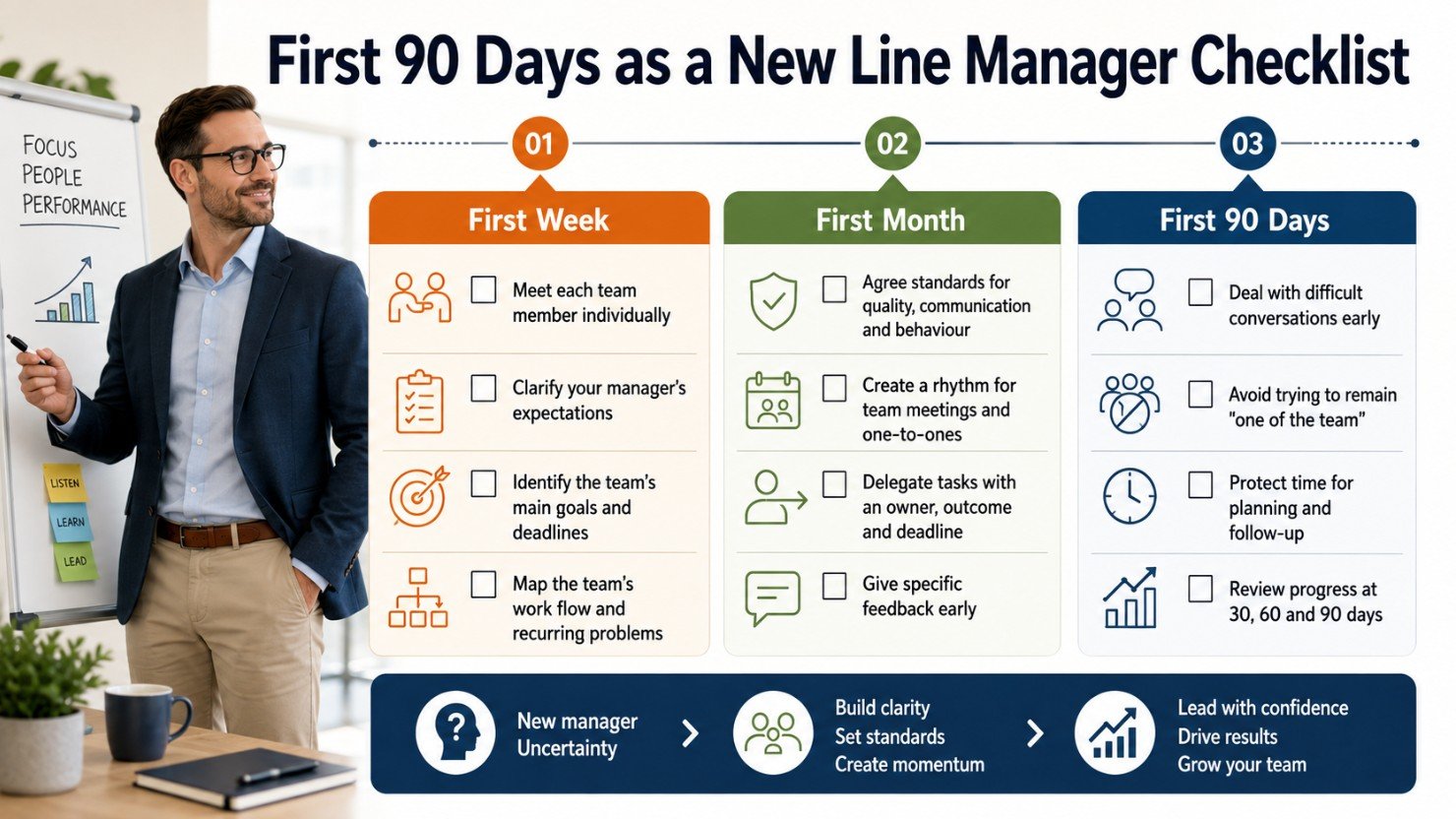
First 90 days as a new line manager checklist
- Meet each team member individually.
- Clarify your manager's expectations for your role.
- Identify the team's main goals and deadlines.
- Map the team's work flow and recurring problems.
- Agree clear standards for quality, communication and behaviour.
- Create a simple rhythm for team meetings and one-to-ones.
- Delegate tasks with an owner, outcome and deadline.
- Give specific feedback early, both positive and corrective.
- Deal with difficult conversations before problems grow.
- Avoid trying to remain only "one of the team".
- Protect time for planning, follow-up and people management.
- Review progress at 30, 60 and 90 days.
When new managers need training
Some people are promoted into management because they were excellent at their previous job. But technical ability does not automatically create management ability. Managing people requires a different set of skills.
The role of a line manager is closely linked to people management, performance and day-to-day employee support. The CIPD has a useful overview of line managers' responsibilities.
New managers need practical methods for setting goals, communicating clearly, delegating work, giving feedback, handling conflict and motivating people. These skills can be learned, practised and improved.
If you are responsible for developing new line managers, a structured First Line Managers Training course can help them build these skills faster and avoid the common mistakes that damage trust and performance.
For managers who need broader development across leadership, planning, communication and performance, see our Leadership and Management Training.
Final thought
Your first 90 days as a manager should create clarity, trust and momentum. You do not need to solve every problem immediately. You do need to set the right direction, agree clear standards and show people that you will manage fairly, consistently and professionally.
The best first time managers do three things well: they listen carefully, they set clear expectations and they follow through. If you do those consistently, you will build the foundation for long-term management success.
To develop these skills in a structured way, explore our First Line Managers Training course.
first 90 days as a new manager
The first 90 days as a new manager is the first work period after a person takes charge of a team for the first time. In this period, the manager learns how the team works, builds trust, agrees clear goals and standards, delegates work with owners and dates, gives feedback and follows up fairly on progress and problems.
CG4D Definition
Context: Business line management
Genus: Work period
- Begins when a person takes charge of a team for the first time.
- Covers the first week, first month and first 90 days in a new line manager role.
- Focuses on learning the team, the work, the goals, the risks and the main problems before major change.
- Requires clear standards, regular one-to-ones, fair delegation, useful feedback and steady follow-up.
Article Summary
A first time manager does well in the first 90 days by listening before making changes, setting clear standards, agreeing the most important work, giving each task an owner and date, giving useful feedback and dealing with small problems early. The aim is not to stay one of the team or fix every problem at once; it is to build trust, clear work habits and a steady way to follow up.