







Quiet Authority in Meetings: How to Lead Without Dominating
Many people think authority in a meeting comes from talking the most. They assume the person who dominates the conversation must be the leader. This is not true.
At the same time, authority does not come from saying nothing. Remaining silent, hoping people will notice your wisdom, rarely works. Both extremes are wrong.
Real authority in a meeting comes from clarity, preparation, organised knowledge and calm communication. This is what we call quiet authority.
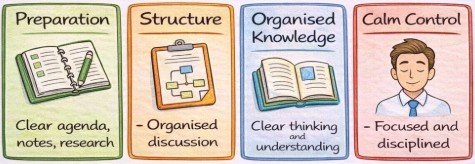
What is quiet authority in meetings?
Quiet authority in meetings is the ability to guide a discussion through preparation, structure, clear thinking and calm communication, without needing to dominate the room. A person with quiet authority influences the meeting by making useful, well-timed contributions that help the group reach a clear decision.
Quiet authority does not mean being passive. It does not mean sitting silently while other people take control. It means you do not try to win influence through noise, pressure or force of personality.
Some people attempt to control meetings by talking constantly, interrupting others, repeating their point, or using a strong tone to push the discussion in their preferred direction. This may look confident at first, but it often signals anxiety, poor preparation, or a need to be seen as important.
A person with quiet authority does something different. They guide the conversation through structure, organised knowledge and calm control of the discussion. Their preparation gives them authority before they even begin to speak.
Why quiet authority works
Quiet authority works because people naturally follow those who bring order to confusion. In many meetings, the problem is not a lack of opinion. The problem is a lack of structure.
People talk around the issue. They repeat points already made. They move too quickly from facts to opinions. They argue about solutions before agreeing what problem they are trying to solve.
The person with quiet authority helps the group think more clearly. They may say:
"Can we pause for a moment and separate the three issues? First, what decision needs to be made? Second, what facts do we have? Third, what options are available?"
That simple intervention can change the whole tone of a meeting. It does not attack anyone. It does not rely on volume. It brings structure, and structure creates confidence.
Quiet authority compared with loud dominance
Loud dominance may gain attention, but quiet authority earns trust. The difference matters, especially for managers, team leaders and anyone who needs to influence others at work.
| Loud dominance | Quiet authority |
|---|---|
| Talks too much | Speaks when it is useful |
| Interrupts others | Listens and summarises |
| Relies on personality | Relies on preparation |
| Creates pressure | Creates clarity |
| Tries to win attention | Helps the group reach a decision |
The best leaders do not need to fill every silence. They understand that influence comes from making the discussion better. They ask better questions. They organise ideas. They turn vague talk into clear decisions.
The three foundations of quiet authority
1. Preparation
Preparation is visible. When someone arrives with clear notes, relevant facts, useful questions, or a simple written structure, the room quickly recognises that they have thought carefully about the issue.
Preparation gives you confidence because you are not trying to invent your thinking in public. You already know the purpose of the meeting, the key questions, the likely objections and the decision that needs to be made.
Before an important meeting, ask yourself:
- What is the purpose of this meeting?
- What decision, if any, needs to be made?
- What facts should be considered?
- What questions will help the group think clearly?
- What outcome would make this meeting useful?
These questions are simple, but they give you an advantage. You enter the meeting with organised knowledge rather than a collection of loose thoughts.
2. Structure
Structure guides the conversation without confrontation. A clear agenda, a written outline, a diagram, or a short list of options can quietly shape the direction of the meeting.
For example, instead of saying, "This meeting is going nowhere," you could say:
"Could we divide the discussion into three parts: the current problem, the possible causes and the practical options?"
This is much more effective. It does not blame anyone. It simply improves the discussion. People usually welcome structure because it reduces confusion and saves time.
3. Calm communication
Calm behaviour creates confidence. People trust those who remain composed, thoughtful and fair, especially when the discussion becomes emotional or confused.
Calm communication does not mean weak communication. You can be calm and still be clear. You can be polite and still be firm. You can listen carefully and still lead the discussion.
The person with quiet authority speaks with discipline. They do not speak merely to prove they are present. They speak when their words will move the meeting forward.
How to develop quiet authority
Quiet authority is a skill. It can be developed through practice, and it is especially useful for managers, first line managers, team leaders and professionals who need to influence others without becoming aggressive or overbearing.
Prepare before the meeting
Know the purpose of the meeting and the key issues that need to be discussed. Write down the main points you want to make. Think about the questions that will help other people reach the right conclusion.
Bring structure into the room
Use an agenda, a list, a model, or a simple diagram. Structure helps people think. It also gives you a natural way to guide the conversation without forcing your personality onto the group.
Listen carefully
Listening is not passive. Good listening gives you the information you need to respond with clarity and precision. When you summarise what others have said, you show respect and regain control of the discussion.
Speak with discipline
When you speak, be brief, clear and relevant. Avoid long explanations when a short sentence would do. Your words should help the group understand the issue, compare options, or agree the next action.
Ask better questions
Questions are one of the best tools of quiet authority. A good question can redirect a confused meeting without sounding forceful. Useful questions include:
- What decision are we trying to make?
- What facts do we know for certain?
- What assumptions are we making?
- What are the practical options?
- Who needs to do what, and by when?
Quiet authority in practice
Imagine a meeting where several people are talking over each other. One person wants an immediate decision. Another person is raising objections. A third person keeps taking the discussion back to an earlier point.
The loudest person may try to take control by raising their voice. The quiet person may withdraw and say nothing. But the person with quiet authority chooses a better route.
They say:
"Before we decide, can we agree the criteria we are using? Are we choosing the fastest option, the lowest-cost option, or the option with the least long-term risk?"
This question changes the discussion. It gives the group a method. It reduces emotion. It helps people compare options against clear standards. That is quiet authority in action.
Why quiet authority matters for managers
Managers are judged not only by what they know, but by how well they help others think, speak and act. Meetings are a major test of that ability.
A manager who dominates every meeting may suppress useful ideas. A manager who says too little may allow confusion to continue. The best manager uses quiet authority to create clarity, encourage useful contributions and move the group towards a decision.
This is why quiet authority is closely linked to leadership and management training, communication skills training and first line manager training. These skills are not abstract theories. They are practical behaviours that improve meetings, decisions and working relationships.
Conclusion
Effective leadership in meetings does not come from forceful personalities. It comes from preparation, organised thinking, calm behaviour and disciplined communication.
Quiet authority allows you to guide a meeting without dominating the people in the room. It helps you speak with confidence, listen with purpose, ask better questions and bring structure to the discussion.
The result is simple: people trust you because you make the meeting better.
Develop stronger leadership and communication skills
Quiet authority is one of the practical leadership skills taught by Corporate Coach Group. Our training helps managers and team leaders run better meetings, structure discussions, communicate decisions and build confidence without becoming aggressive or overbearing.
Explore our Leadership and Management Training Course, Communication Skills Training Course, or our wider corporate training programmes.
quiet authority in meetings
Quiet authority in meetings is a meeting leadership skill used at work. It means guiding a group with clear preparation, simple structure, careful listening and calm speech, so people focus on facts, options and the decision needed. It is not silence or loud control; it helps the group think clearly and agree useful next steps.
CG4D Definition
Context: Workplace leadership and management meetings
Genus: Meeting leadership skill
- Guides the group through preparation before the meeting
- Uses clear structure to turn unclear talk into facts, options and decisions
- Listens and asks useful questions before giving a view
- Communicates calmly without trying to dominate the room
Article Summary
Quiet authority in meetings is the skill of leading a group through preparation, structure, calm communication and useful questions, without trying to dominate the room. It works because people trust the person who brings order to unclear talk, helps the group focus on facts and options, and moves the meeting towards a clear decision.