







ABC: How to Change People's Behaviour at Work and at Home
We all would like to be able to change people's behaviour, but the question is: how is that best done?
Psychologists have devised a useful method called the ABC method. ABC is a form of behavioural conditioning and is a practical model for understanding and improving behaviour at home and at work.
The basic idea is that we can change behaviour by changing what comes before it, or by changing what follows it.
In the ABC model:
- A means antecedent.
- B means behaviour.
- C means consequence.
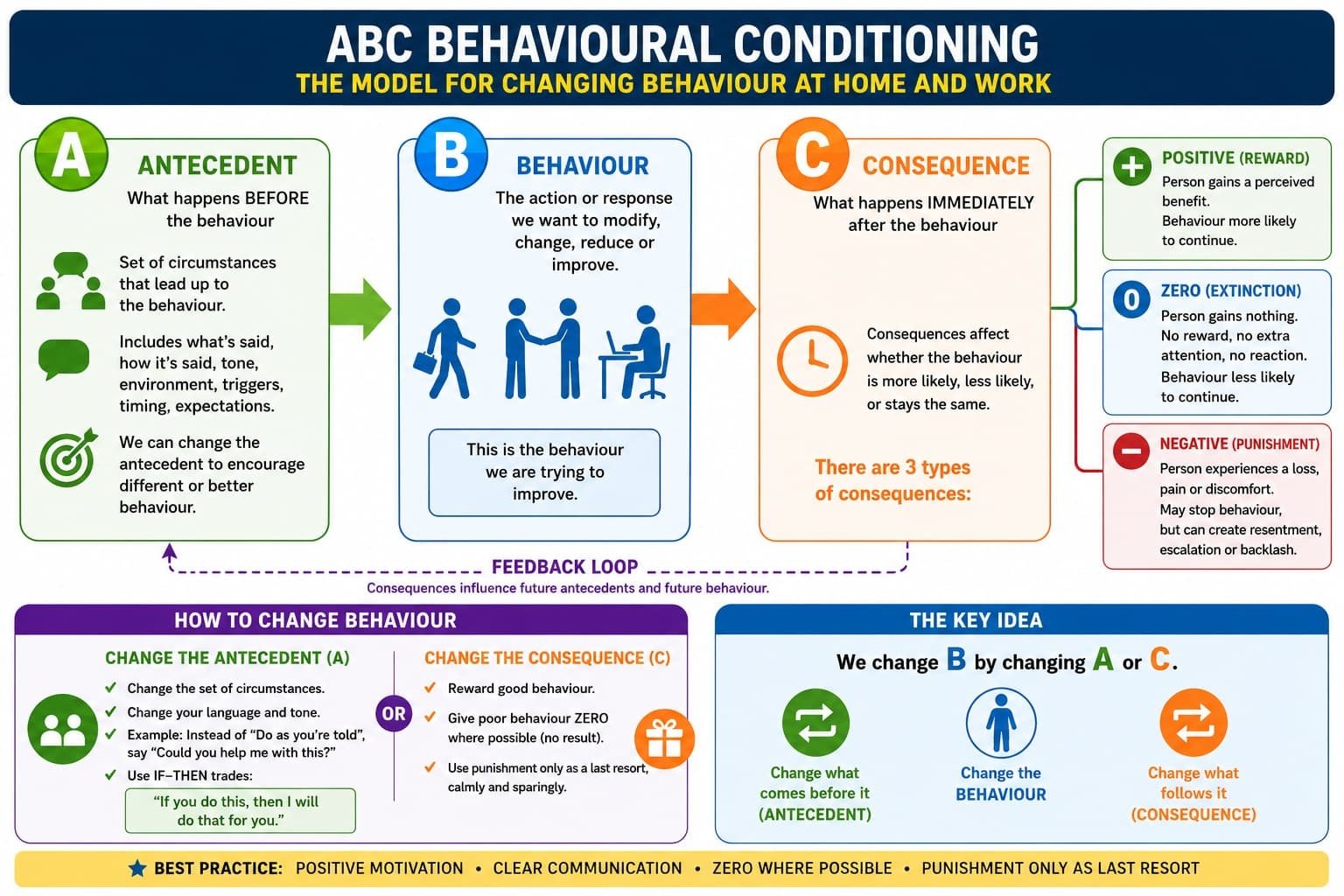
A: Antecedent, or Activating Set of Circumstances
The antecedent is the activating set of circumstances that comes before the behaviour. It is the situation, wording, tone, request, environment, or trigger that leads into the behaviour.
The antecedent can be seen as part of the cause of the behaviour. If we modify the lead-up to the behaviour, we may get a different behaviour, or a better behaviour.
One simple way to change the antecedent is to change our language.
Instead of saying, "Do as you're told," we might say, "Would you please help me with this?" or "Would you please do this for me?"
That change in wording changes the emotional meaning of the request.
Another way to change the antecedent is to use an if-then trade.
For example: "If you do this for me, then I will do that for you."
This gives the other person a positive reason to act.
B: Behaviour
The behaviour is the thing we are trying to modify, change, or improve.
The behaviour is what the person does after the antecedent.
At home, it may be helping, refusing, delaying, arguing, cooperating, or withdrawing.
At work, it may be meeting a standard, missing a standard, taking action, avoiding action, helping the team, or causing difficulty.
C: Consequence
The consequence is what happens immediately after the behaviour has taken place.
The consequence matters because it affects whether the behaviour becomes more likely, less likely, or stays the same.
Consequences break into three types:
- Positive consequence: reinforcement.
- Zero consequence: extinction.
- Negative consequence: punishment.
Positive Consequence: Reinforcer
A positive consequence means the person gains a perceived benefit by doing what they are doing.
The word perceived matters. It is not an objective measure. It is a subjective measure.
If the person perceives a benefit, then they are more likely to continue the behaviour.
A perceived benefit might be attention, control, praise, money, approval, comfort, status, or escape from a task.
Zero Consequence: Extinction
A zero consequence means the person gains nothing from the behaviour.
Nothing useful happens. No reward appears. No drama is created. No extra attention is gained.
This is a very powerful concept.
In behavioural terms, this is called extinction. A behaviour is extinguished when it produces absolutely nothing.
People act in order to gain something, or to avoid something. If absolutely nothing happens, the behaviour becomes less likely.
Imagine putting a coin into a chocolate machine. You press the button, but no chocolate bar appears. You gain nothing. You are less likely to put money into that machine again.
Behaviour works in a similar way. If effort produces nothing, then the person becomes less likely to repeat that effort.
Negative Consequence: Punishment
A negative consequence means the behaviour brings a painful consequence.
This is punishment.
Punishment is a dangerous method because it can easily escalate behaviour.
It can also be perceived as a positive benefit, especially if the punishment gives the person attention.
Attention is highly valued by many people, even when the attention is negative.
This is where many people go wrong. They think only in terms of punishment and reward, which is a binary system.
The better model is three-part: reward, zero, punishment.
The Best Practical Rule for Behaviour Change
The best way forward is often zero gain for bad behaviour, rather than punishing bad behaviour.
Punishment does not work well as a main method of behaviour change because it creates bad blood, resentment, hatred, and even revenge.
Use the ABC model more sensitively and carefully.
Improve the antecedent by improving the wording, voice tone, and body language. Change the tone. Change the setup. Appeal to people by offering a trade: "If you do this, then I will do that."
After the behaviour occurs, ensure the consequences are well thought through. Reward good behaviour. Do not accidentally reward bad behaviour. Give poor behaviour zero result where possible.
Use punishment sparingly, calmly, and only when it is absolutely necessary.
Key Principle of the ABC Method
We change behaviour by changing what comes before it, and what follows from it.
ABC model
The ABC model is a simple behaviour tool used at work and home. It breaks each act into what comes before it, the act itself, and what happens straight after. By changing the trigger or the result, we can steer what people do. It deals only with acts we can see and with clear rewards, silence, or penalties.
CG4D Definition
Context: Workplace and home behaviour management
Genus: Model
- Splits every behaviour case into antecedent, behaviour, and consequence parts.
- Aims to change acts by altering the trigger or the result, not the person.
- Works on acts that can be seen and timed, not on hidden thoughts.
- Uses reward, no payoff, or penalty right after the act to shape future acts.
Article Summary
Change any act by changing what comes before it and what comes after it. Shape the start with kind words or a clear trade, then give reward or calm silence, not blame. The ABC model proves this simple rule shifts actions in the office and at home.