







What is Common Sense?
Common sense is "everyday logic".
The term "common sense" was first coined by Aristotle, the ancient Greek philosopher, who said that humans were the only animal on the planet equipped with an innate sense of logic. Aristotle said everyone is born with the potential to think logically, therefore logic is the COMMON sense. (ie the logical sense is common to all humans).
What does common sense logic mean in practice?
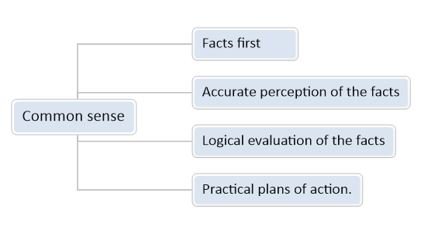
There are three distinguishing characteristics of common sense:
- A facts first system.
- A rejection of mystical or magical explanations.
- Always practical and workable.
1. The first rule of common sense is: Get the facts.
Common sense is a facts first system of thought. It is reality based. Common sense is about dealing with the world as it really is, not how you feel it should be.
Therefore, you need to ensure you don't make decisions based on instinct, vague feelings, rumour, guesses or fake news.
Check your facts and check your sources.
Sherlock Holmes said, "It is a capital mistake to theorize before one has the facts".
2. Common sense implies a rejection of mystical or magical methods.
Common sense means we reject methods that rely on luck, chance, fate, the stars, destiny, the spirits, or that things happen "somehow".
Common sense tells us that people don't pass exams, just because they are lucky, or win races because fate is on their side.
People do not fail because "now is not their time".
Common sense looks for non-mystical, non-religious, non-magical explanations and methods.
If something happens, then it happens due to worldly, natural causes, NOT supernatural, magical, or religious causes.
So common sense is a logical, factual, scientific way of looking at things.
3. Practical and workable.
Because common sense is factual, it is also practical.
Because it is scientific, it is also pragmatic.
Therefore, all your theories must be practical, workable and achievable in the real world. Therefore, never evade facts you don't like and never invent facts you wish were true.
How can you develop common sense?
Resolve to deal with the world head-on; take a hard-headed, practical, factual, non-mystical approach to your life and its problems.
If you do that, then people around you will say you have plenty of common sense.
common sense
In personal effectiveness, common sense is a thinking skill that puts checked facts first, throws out magic and fate, hunts for ideas that work in real life, and lives in every person. If any one of these parts is missing, we cannot call it common sense. It is simple, clear logic for daily use.
CG4D Definition
Context: Personal effectiveness
Genus: Thinking skill
- Puts checked facts first
- Rejects magic or fate based causes
- Seeks ideas that work in real life
- Open to every person
Article Summary
Common sense is everyday logic: put facts first, ignore magic ideas and choose acts that work in real life. When you test each idea against proof, you dodge errors, solve problems fast and earn trust. Clear, practical thinking is a skill anyone can grow.