







Is the Karpman Drama Triangle Good for Resolving Conflicts?
The Karpman Drama Triangle is NOT a good method to understand how to resolve conflicts, because the method instructs us which behaviours do NOT work, rather than telling us which behaviours do work.
Models which tell us which behaviours do NOT work, are of strictly limited value.
If we learn that the right answer to a problem is NOT nine, or ten, or fifteen, then how much useful knowledge have we gained?
Not much!
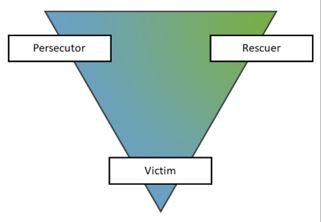
The Karpman Drama Triangle gives us three behaviours, which are represented by three points forming a triangle.
We are told that the space inside the triangle represents what NOT to do because these three behaviours do NOT work.
The solutions to our conflict problems are to be found OUTSIDE The Karpman drama triangle - "Somewhere".
The Three Behaviours of the Karpman Drama Triangle.
The three behaviours of the Karpman Drama Triangle are: Victim, Rescuer, Persecutor.
1. The Victim
In conflict situations, don't act as though you are a victim of others. This only serves to weaken your self-image and lends emotional strength to others.
2. The Rescuer
In conflict situations, don't pretend to be the rescuer of victims. Maybe other people don't want to be rescued by you, because they don't have a victim mentality.
And if they DO have a victim mentality, then the arrival of the "Rescuer" reinforces victims' low opinion of themselves.
3. The Persecutor (aka Villain)
In conflicts, don't perform the role of The Persecutor (the Villain) because these terms imply a host of bad behaviours: being aggressive, threatening, oppressive authoritarian, rigid, and bullying.
If solutions to conflict problems are found only outside the Karpman drama triangle behaviours, then what positive skills sets DO we need, in order to best resolve conflicts?
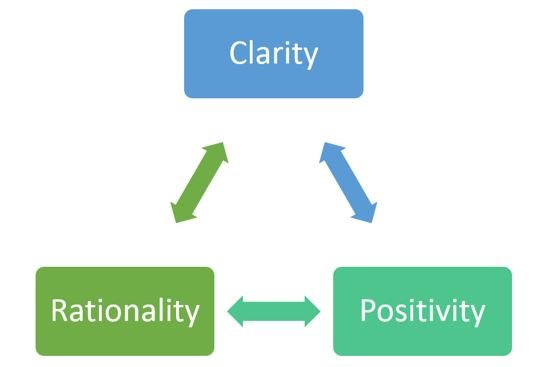
The Clear, Rational, Positive Triangle.
The three correct principles that underpin the correct answers to conflict management are: Clarity, Rationality, Positivity.
1. Clarity
We manage conflicts using only clear ideas, clearly expressed. We are always able to make ourselves clearly understood.
2. Rationality
We manage conflicts according to rational principles: ie we find solutions by reference to facts, logic, objectivity, written policies and laws.
3. Positivity
Our intentions are always honourable and positive: We intend to find practical solutions that are mutually beneficial to all parties, and which represent a mutual exchange of values.
Conflict Handling Training
If you want to learn exactly how to resolve conflicts according to clear, rational and positive principles, we recommend you attend our Conflict Handling training course.
Karpman Drama Triangle
The Karpman Drama Triangle is a conflict model used at work and at home. It shows three unhelpful roles – victim, rescuer and persecutor – placed on the corners of a triangle. The idea is that people switch between these roles, keeping the fight going. It helps spot bad habits but offers no clear way to fix them.
CG4D Definition
Context: Conflict management
Genus: Model
- Lists three bad roles: victim, rescuer, persecutor
- Draws the roles on a triangle shape
- Shows people move from one role to another, which keeps the argument going
- Used to spot harmful conflict habits, not to give fixes
Article Summary
Because the Karpman Drama Triangle lists roles to avoid, it fails to solve disputes; we fix conflict when we speak with clear words, calm logic and positive aims that help all sides win.