







Constructive criticism is a form of feedback.
Feedback is important information, because it relates the results of our recent actions to our goals
Feedback comes in two forms, positive feedback and negative, (critical).
- Positive feedback tells us that our recent actions are working well and are taking us in the direction of our goals.
- Critical feedback, (constructive criticism), tells us that our recent actions are NOT working, i.e. our recent actions are NOT taking us in the direction of our goals, or worse, they are taking us in the opposite direction, AWAY from our goals!
Most people love to hear positive feedback, which comes in the form of praise.
Most people enjoy hearing that they are "doing a fine job", and that their "behaviour is excellent", that they are making "terrific progress".
When people hear positive feedback, how do they respond emotionally?
Most people feel motivated, inspired, encouraged and happy, whenever they are in receipt of positive praise.
BUT....
Most people hate to hear negative feedback, which comes in the form of Criticism.
Most people dislike hearing that they are NOT doing well, or that their recent behaviour is NOT up to the agreed standard, or that they are NOT making the expected progress, or worse, that they are getting worse!
When people hear negative feedback, how do they usually respond emotionally?
Most people feel demotivated, angry, upset, insulted and unhappy, whenever they are in receipt of negative, critical feedback. Consequently, they become defensive, or aggressive, they often try to justify their bad behaviour or to deflect the conversation onto something else. They often feel victimised and downhearted. Many people become stubborn and inflexible. They refuse to change, even though they may recognise that some of the criticisms are justified.
What are the painful consequences that must befall people who, when in receipt of valid, accurate, but critical feedback, become angry, upset, evasive and refuse to change?
People who refuse to accept negative feedback in a positive way, are more likely to continue to make the same mistakes, every day, for years.
Consequently, they never progress beyond their current position because they never evolve and adapt according to the feedback results their recent actions have been creating.
They become fossilised versions of their earlier selves, and never make any progress, instead, they just get older.
How SHOULD people respond to critical feedback?
The correct response to critical feedback is as follows:
- The most important thing is to listen to it! Be open to criticism. Don't automatically blank it out, or attack the person giving the message.
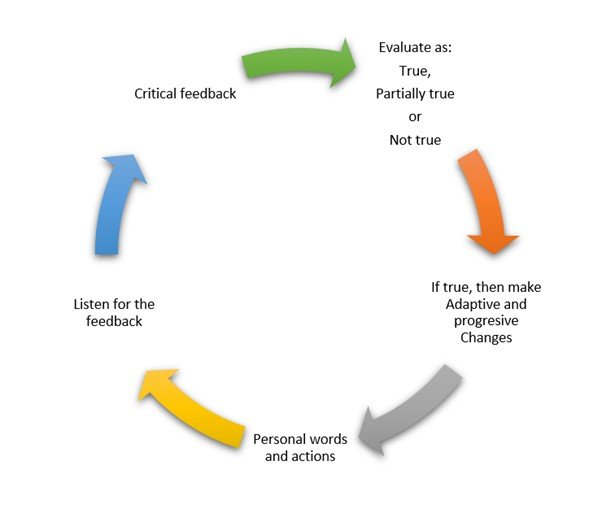
- When you have listened to it, (without interruption), ask yourself, "Is this criticism of my performance true, or at least, partially true?" Every criticism of your performance will be either; True, partially true, or NOT true.
- If the criticism of you is NOT true, then you can safely ignore it, and continue about your business.
- If the criticism of you is either True, or Partially true, then move to step 5.
- Ask yourself, "If this criticism of me is (at least partially) true, then what would happen to me and my family, if I continue to repeat the same error?". Think about the painful consequences of NOT changing. Then move to step 6.
- Ask yourself, "Based upon an analysis of the negative feedback, my recent actions have created, what adaptive changes, or improvements or modifications, to my behaviour would most likely result in improved results in the future?".
- Think carefully about how you could improve your words, and behaviour in ways which will most likely garner positive results in the future. Then take step 7.
- Implement the adaptive changes (improvements) to your words and behaviours.
- Feel good about yourself for having the wisdom sufficient to allow you to abandon bad habits in favour of better ones.
- Keep observing and listening out for the feedback results of your most recent actions and be ready to accept praise (for good performances) and valid criticism for POOR performances.
- Repeat the cycle shown below and continue to successfully adapt yourself to the ever-changing environment.
Constructive criticism
In business, constructive criticism is feedback that shows where your action misses the agreed goal, explains why that matters, gives clear steps to improve, and is shared with respect to help you grow. If any of these parts is missing, the comment is no longer constructive criticism.
CG4D Definition
Context: Business
Genus: Feedback
- Shows the gap between current action and agreed goal
- Explains why the change is important
- Gives clear advice for improvement
- Delivered with respect to support growth
Article Summary
Constructive criticism is real-time guidance; when you listen, test its truth and act, you turn a bruised ego into a sharper skill and convert every piece of feedback into progress.